Market Pulse
U.S. commercial crude oil inventories increased by 3.0 million barrels to 426.4 million barrels for the week ending September 18, according to the U.S. Energy Information Administration (EIA). Inventories are now approximately 2% above the five-year average for this time of year. The build followed the American Petroleum Institute’s (API) reported increase of 1.786 million barrels.
Despite the inventory build, crude futures moved higher Wednesday morning. Brent was trading at $101.40 per barrel, up $2.15, or 2.17%, while WTI reached $92.00 per barrel, up $1.47, or 1.63%. Both benchmarks remained below levels seen the previous week.
Gasoline inventories declined by 1.7 million barrels, following an 800,000-barrel increase the prior week, with production averaging 9.6 million barrels per day. Middle distillate inventories fell by 400,000 barrels, while production averaged 5.2 million barrels per day. Distillate inventories remain approximately 12% below the five-year average.
Total products supplied, a proxy for U.S. petroleum demand, averaged 20.6 million barrels per day over the past four weeks, up 0.5% year over year. Gasoline demand averaged 8.8 million barrels per day, while distillate supplied averaged 3.6 million barrels per day, down 0.3% year over year.
U.S. propane inventories also declined amid strong exports, which we expect to continue. Even a relatively warm winter may not be sufficient to offset sustained export demand, supporting further inventory normalization.
At Mont Belvieu, the current price gap with the Far East is expected to narrow over time. A move from approximately 80 cents per gallon to 50 cents would represent a 30-cent-per-gallon upside opportunity heading into winter.
Fundamentals
EIA’s Weekly Petroleum Inventory in MM’s BBLS
| Commodity | US Inventory | Change | 5 Yr Ave | CURRENT MARKETS |
|---|---|---|---|---|
| Crude Oil | 426.4 | 3.0 | 418 | WTI Crude: -3.89 |
| Gasoline | 206.0 | -1.7 | 218 | RBOB: -0.0286 |
| Distallates | 107.4 | -0.4 | 122 | Heating Oil: -0.0631 |
| Commodity | US Inventory | Change | Midwest Invent | Change |
|---|---|---|---|---|
| Propane | 107.9 | -1.2 | 26.1 | -0.2 |
Propane
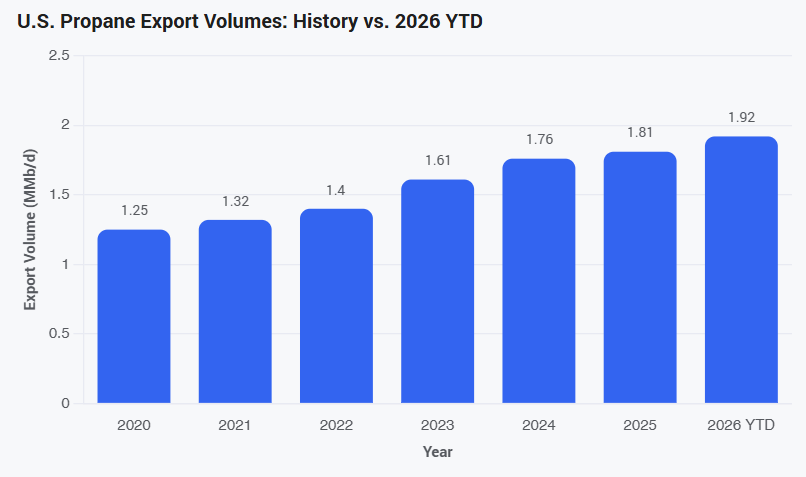
Conway and Hattiesburg moved modestly higher on Tuesday, while Belvieu remained firm at $0.84. Despite healthy propane inventories heading into winter, prices typically strengthen relative to crude during the fall, providing underlying support even as crude prices decline.
Looking ahead, inventory reports could show either draws or builds as strong production is weighed against rising domestic and international demand.
Could a U.S. Diesel Export Ban Simply Kick Higher Prices Down the Road?
The prospect of restrictions on U.S. diesel exports is creating an unusual dynamic in global refined-product markets. European diesel has been trading significantly stronger while NYMEX heating oil, the primary U.S. diesel benchmark, has moved in the opposite direction.
The divergence becomes easier to understand when considering how an export restriction would affect the U.S. refining system. A diesel export ban could lower U.S. diesel prices in the short term by keeping more barrels at home. However, it would not create additional diesel supply. It would primarily change where existing barrels are sold.
The United States is a major exporter of diesel and other refined products, while Europe depends heavily on imports. If U.S. exports were restricted, barrels that normally would move overseas would remain in the domestic market. That would likely increase U.S. inventories and put downward pressure on NYMEX HO, diesel cracks and refinery margins.
The immediate result could be attractive for U.S. consumers, but the impact on refiners is more complicated.
U.S. refiners have been operating at high utilization rates, and some maintenance has been deferred while refining margins have remained attractive. If diesel cracks fall substantially because export demand disappears, the economics of running every available barrel change. Refiners could reduce utilization or take advantage of weaker margins to bring forward maintenance that had previously been postponed.
That creates an important potential feedback loop. More diesel staying in the United States could initially push prices lower, but weaker refinery margins could eventually cause refiners to produce less diesel. If refinery production falls enough, the initial surplus could disappear and domestic supplies could tighten again.
This is where the idea of an export ban potentially “kicking the can down the road” becomes important. The policy can redistribute existing diesel supply, but it does not necessarily create more refining capacity or additional barrels.
The international market adds another layer. Removing U.S. diesel from the export market would leave Europe and other importing regions competing for replacement supplies. That could push European gasoil prices and margins higher even as U.S. diesel prices fall. In effect, the shortage would be redistributed rather than eliminated.
The longer the restrictions remained in place, the more important refinery utilization and maintenance would become. If refiners continued operating at high rates, the United States could absorb the additional barrels and maintain lower prices. But if weaker margins led to significant reductions in refinery runs and accelerated maintenance, the domestic market could eventually become tight again.
That is why refinery utilization may be just as important to watch as NYMEX HO itself. A falling HO price accompanied by strong refinery runs would indicate a genuine increase in domestic availability. A falling HO price followed by declining refinery utilization would suggest that refiners are responding to weaker economics and setting the stage for tighter supply later.
Ultimately, a diesel export restriction is better viewed as a supply-allocation policy than a supply-creation policy. It can keep more barrels in the United States, but it does not solve the underlying limitations of refining capacity.
In the short term, an export ban could mean lower U.S. diesel prices. Over time, however, if weaker margins cause refiners to cut runs and accelerate deferred maintenance, production could fall enough to tighten the domestic market again. At the same time, fewer U.S. barrels would be available to Europe, potentially making the global diesel market even tighter.
The result could be that an export ban provides short-term relief while simply moving the pressure, and potentially higher diesel prices, further down the road.
Humor

Disclaimer: The data, information and related graphics (collectively, “Information”) is for general information use only and is compiled from sources believed to be reliable. Dale Petroleum Company does not guarantee its accuracy or completeness, nor does DPC assume any liability for any inaccurate or incomplete information. The Information is not intended to be a research report nor an analysis of a company and it should not be relied upon for making investment decisions. The information is subject to change without notice, is for general information only and is not intended as any offer or solicitation with respect to the purchase or sale of any financial instrument or as personal investment advice.