Market Pulse
U.S. crude inventories fell 7.6 million barrels, including a 3.1 million-barrel draw from the SPR, as exports strengthened and refinery runs reached 17.5 million barrels per day. EIA data showed commercial crude stocks declined 4.5 million barrels for the week ending August 28 to 424.5 million barrels, roughly 1% above the five-year average. API had reported a 2.6 million-barrel draw.
Gasoline inventories declined 1.1 million barrels, with demand slightly above year-to-date levels. Distillate inventories increased 800,000 barrels, although stocks remain 14% below the five-year average. Propane inventories fell 2.1 million barrels amid strong demand and exports of approximately 2.15 million barrels per day.
At 10:18 a.m. ET, Brent was trading at $94.01/bbl, down 0.68% on the day but approximately $7/bbl higher week over week. WTI was at $89.24/bbl, down 1.09% but roughly $8/bbl higher than the same time last week.
Total products supplied averaged 20.4 million bpd over the past four weeks, down 4% year over year. Gasoline demand averaged 8.9 million bpd, while distillate demand averaged 3.7 million bpd, down 6% year over year.
Fundamentals
EIA’s Weekly Petroleum Inventory in MM’s BBLS
| Commodity | US Inventory | Change | 5 Yr Ave | CURRENT MARKETS |
|---|---|---|---|---|
| Crude Oil | 424.5 | -4.5 | 432 | WTI Crude: -0.27 |
| Gasoline | 205.7 | -1.2 | 222 | RBOB: 0.0357 |
| Distallates | 104.2 | 0.8 | 119 | Heating Oil: 0.0166 |
| Commodity | US Inventory | Change | Midwest Invent | Change |
|---|---|---|---|---|
| Propane | 107.4 | -2.1 | 26.2 | -0.5 |
Propane
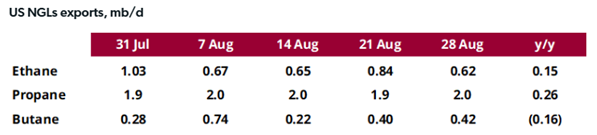
Propane prices staged a slight rebound to close out last week, finishing higher despite record inventory levels. That momentum has continued into this week, with prices following the broader energy markets higher and approaching a $0.03 per gallon increase.
Additional upward pressure could develop as attacks on tankers in the Strait of Hormuz have increased this week, raising concerns around global energy supply and transportation. Further tightening could also result from Saudi Aramco, a major propane supplier to Asia, notifying customers that it will be unable to supply propane during the first half of 2027 due to scheduled maintenance.
This disruption could place additional pressure on U.S. Gulf Coast propane exports as international buyers look to the United States to help offset reduced Asian supply.
Trump Turns Up Pressure on Refiners as Washington Targets Fuel Prices
President Donald Trump’s meeting with U.S. oil and refining executives Tuesday sent a clear message: Washington wants more fuel in the domestic market and is willing to use policy to make it happen.
The administration’s strategy appears focused on three areas—more crude supply, higher refinery output and fewer logistical constraints on moving barrels. With U.S. refineries already operating at exceptionally high utilization rates, regulatory and transportation changes could have a more immediate impact than building new refining capacity.
Jones Act in Focus
The Jones Act could become an important part of the strategy. Restrictions on vessels moving cargo between U.S. ports can make it costly to reposition crude and refined products between regions. Greater flexibility could allow Gulf Coast refiners to move gasoline and diesel more efficiently into markets facing tighter supplies, improving distribution without creating additional barrels.
Diesel Exports a Key Wild Card
The biggest near-term question is whether Washington moves to restrict diesel exports. There is no indication that an export ban was agreed to during Tuesday’s meeting, but the possibility is gaining attention as domestic diesel prices remain elevated and inventories are roughly 14% below the five-year average.
The U.S. exports significant volumes of diesel, particularly from the Gulf Coast. Redirecting some of those barrels domestically could quickly increase supply and pressure diesel prices and distillate cracks lower. The trade-off is weaker refinery economics, as exports provide an important outlet for U.S. production.
Venezuela Adds Supply
The administration is also pushing for more Venezuelan crude to enter the U.S. refining system. Additional heavy crude could be particularly valuable to Gulf Coast refiners and, combined with high refinery utilization, support greater product output.
Market Implications
Recent EIA data showed commercial crude inventories falling 4.5 million barrels for the week ending August 28, while gasoline stocks also declined. Distillate inventories increased by 800,000 barrels but remain well below historical levels.
The policy developments therefore create a potentially bearish setup for U.S. diesel cracks if export restrictions are implemented or Jones Act relief allows Gulf Coast barrels to move more freely into domestic markets.
For crude, the impact is less clear. More Venezuelan supply could support refinery runs and crude demand, while weaker product cracks could eventually reduce refinery appetite for crude.
The key market variables to watch are Venezuelan crude flows, any formal action on diesel exports and the scope of Jones Act relief. Together, these measures could materially increase domestic product availability without waiting years for new refining capacity.
Fun

Disclaimer: The data, information and related graphics (collectively, “Information”) is for general information use only and is compiled from sources believed to be reliable. Dale Petroleum Company does not guarantee its accuracy or completeness, nor does DPC assume any liability for any inaccurate or incomplete information. The Information is not intended to be a research report nor an analysis of a company and it should not be relied upon for making investment decisions. The information is subject to change without notice, is for general information only and is not intended as any offer or solicitation with respect to the purchase or sale of any financial instrument or as personal investment advice.