Market Pulse
U.S. crude inventories declined 0.6 MB for the week ending September 11, bringing commercial stocks to 423.4 million barrels, approximately 1% above the five-year average. Higher crude exports contributed to the draw, with roughly 0.4 MB also coming from the SPR. We expect strong U.S. crude exports to continue, putting further downward pressure on domestic inventories in the near term.
Gasoline inventories increased 0.8 MB, while distillate stocks rose 1.6 MB as lower domestic demand offset continued strong exports. Distillate inventories remain approximately 13% below the five-year average. Propane inventories fell 1.4 MB, with exports remaining elevated at approximately 2.2 MB/day.
Total petroleum products supplied averaged 20.5 MB/day over the past four weeks, down 0.6% year over year. Gasoline demand averaged 8.8 MB/day, while distillate demand averaged 3.6 MB/day, down 3.3% year over year.
Crude prices were lower on the day, with Brent at $107.36/bbl and WTI at $103.80/bbl, although both remained above levels seen at the same time last week.
Fundamentals
EIA’s Weekly Petroleum Inventory in MM’s BBLS
| Commodity | US Inventory | Change | 5 Yr Ave | CURRENT MARKETS |
|---|---|---|---|---|
| Crude Oil | 423.4 | -0.6 | 420 | WTI Crude: -3.89 |
| Gasoline | 207.7 | 0.8 | 218 | RBOB: -0.0286 |
| Distallates | 107 | 1.6 | 124 | Heating Oil: -0.0631 |
| Commodity | US Inventory | Change | Midwest Invent | Change |
|---|---|---|---|---|
| Propane | 109.1 | -1.4 | 26.3 | -0.3 |
Propane
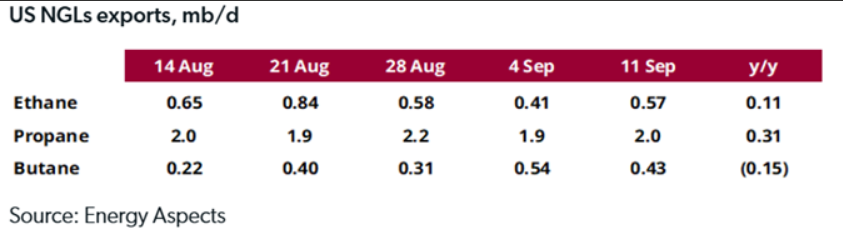
Propane prices closed sharply higher last week, despite crude oil prices trending lower into the end of the week. Each major propane hub finished approximately 5 cents higher, bringing gains to nearly 10 cents since the beginning of August as strong international demand for U.S. propane continues to support the market.
Overall propane inventories have surpassed record levels. However, Midwest inventories remain within the five-year high-low range and could remain relatively rangebound as barrels continue to move south toward the Gulf Coast, where export pricing remains significantly more attractive.
What Would a U.S. Diesel Export Ban Mean for Diesel Prices?
A U.S. diesel export ban could have opposite effects on U.S. and global diesel prices. The key is the relationship between the global diesel market and the U.S. physical basis.
The Basic Mechanism
U.S. diesel prices are closely connected to global prices through international trade and arbitrage. When U.S. diesel is cheaper than overseas diesel, traders can export U.S. barrels, which tends to keep regional prices aligned. An export ban would disrupt that mechanism. If U.S. exports were sharply reduced:
Exports ↓ → more diesel stays in the U.S. → inventories build → U.S. physical supply loosens → U.S. basis weakens.
At the same time:
U.S. exports ↓ → less diesel available globally → foreign buyers seek replacement barrels → global diesel prices ↑.
Thus, the U.S. could see a lower price relative to the international market, even while the global diesel benchmark rises.
Why the U.S. Basis Matters
The potential decline in U.S. diesel prices would primarily be a basis story, not necessarily a decline in the underlying global diesel price.
For example, if global diesel rose from $5.50 to $5.70 per gallon equivalent, but U.S. basis weakened by 20 cents because excess barrels were trapped domestically, the U.S. price could remain around $5.50.
Normally, arbitrage would close that gap by moving U.S. diesel overseas. An export ban prevents that from happening.
Inventories Are the Key
The most important question would be whether the retained barrels cause U.S. inventories to build. If domestic demand absorbs the additional supply, the effect on U.S. prices could be limited. If inventories rise significantly, physical sellers would have to discount diesel to clear the excess supply, putting downward pressure on U.S. basis and potentially on the price at the pump. This makes U.S. distillate inventories and Gulf Coast physical basis two of the most important indicators to watch.
The Global Effect
For the rest of the world, the effect would likely be more straightforward: removing a major source of U.S. diesel exports would tighten the international market.
Europe, Latin America and other importing regions would need to find replacement barrels from other suppliers, potentially pushing global diesel prices higher.
The result could therefore be:
- U.S. inventories: ↑
- U.S. physical basis: ↓
- U.S. diesel relative to global prices: ↓
- Global diesel prices: ↑
- Global diesel availability: ↓
What to Watch
If an export restriction is implemented, the most useful indicators would be:
- U.S. distillate inventory changes
- Gulf Coast diesel basis
- U.S. diesel export volumes
- Refinery utilization
- U.S.–Europe diesel arbitrage
- European and global diesel inventories
- NYMEX ULSD and the diesel crack spread
Bottom Line
A U.S. diesel export ban would not necessarily make diesel cheaper everywhere. It could make global diesel more expensive while causing the U.S. basis to weaken.
The central mechanism is:
Less U.S. exports → more barrels trapped domestically → U.S. inventories build → U.S. basis weakens.
So if you’re evaluating the potential bearish case for U.S. diesel, the most important thing to watch is whether the export restriction actually produces a sustained domestic inventory build and weaker physical basis.
Humor

Disclaimer: The data, information and related graphics (collectively, “Information”) is for general information use only and is compiled from sources believed to be reliable. Dale Petroleum Company does not guarantee its accuracy or completeness, nor does DPC assume any liability for any inaccurate or incomplete information. The Information is not intended to be a research report nor an analysis of a company and it should not be relied upon for making investment decisions. The information is subject to change without notice, is for general information only and is not intended as any offer or solicitation with respect to the purchase or sale of any financial instrument or as personal investment advice.