Market Pulse
The latest U.S. Energy Information Administration (EIA) data presents a moderately bullish outlook for the oil market. U.S. commercial crude oil inventories declined by 3.2 million barrels for the week ending October 2, bringing total stockpiles to 424.1 million barrels, approximately 1% above the five-year average for this time of year. The drawdown was larger than the 2.09-million-barrel decline previously reported by the American Petroleum Institute (API), providing additional support for crude prices. At the time of the report, Brent crude was trading at $101.79 per barrel, up 1.20% on the day, while West Texas Intermediate (WTI) was at $89.92 per barrel, up 0.54%.
Product inventories presented a mixed picture. Gasoline inventories increased by 400,000 barrels following a 1.7-million-barrel decline the previous week, while average gasoline production remained strong at approximately 9.3 million barrels per day. Middle distillate inventories were essentially unchanged, although they remain 12% below the five-year average, indicating continued tightness in that segment of the market. Meanwhile, total products supplied, a proxy for U.S. petroleum demand, averaged 21.1 million barrels per day over the past four weeks, representing a 0.7% increase from the same period last year. Gasoline demand averaged 8.8 million barrels per day, while distillate demand averaged 3.8 million barrels per day, down 1.6% year over year.
Overall, the report provides modest support for crude oil prices, primarily due to the larger-than-expected decline in crude inventories and continued strength in overall petroleum demand. However, the bullish impact is somewhat limited by crude inventories remaining slightly above the seasonal five-year average and the recent increase in gasoline stocks. The continued deficit in distillate inventories remains a notable source of market tightness and could provide additional support for refined-product prices and refinery demand for crude. Taken together, the latest EIA data suggests a mildly bullish fundamental backdrop for the oil market, rather than a significant shift in the overall supply-demand balance.
Fundamentals
EIA’s Weekly Petroleum Inventory in MM’s BBLS
| Commodity | US Inventory | Change | 5 Yr Ave | CURRENT MARKETS |
|---|---|---|---|---|
| Crude Oil | 424.1 | -3.2 | 425 | WTI Crude: -1.13 |
| Gasoline | 204.7 | 0.4 | 219 | RBOB: -0.043 |
| Distallates | 105.1 | 0.0 | 118 | Heating Oil: 0.035 |
| Commodity | US Inventory | Change | Midwest Invent | Change |
|---|---|---|---|---|
| Propane | 107.8 | -1.8 | 25.7 | 0.0 |
Propane
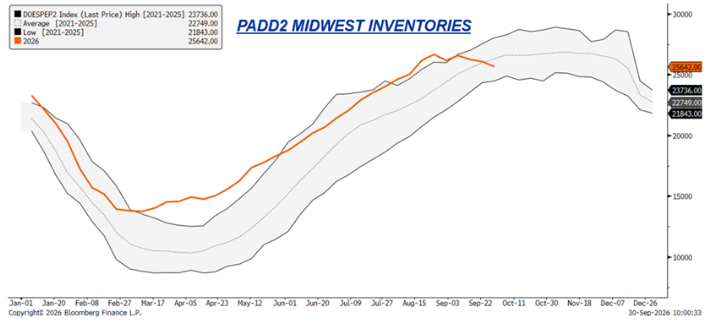
Propane prices increased again in Conway on Monday, while prices in the export market and at Hatties remained stable. Strong dryer demand across the Midwest, combined with continued export opportunities to move barrels south, helped keep Conway inventories at more manageable levels. On Tuesday, propane prices moved independently of crude oil, increasing by approximately $0.02 at several major hubs. At the same time, higher propane prices and rising freight costs are beginning to influence Asian demand, with some buyers shifting toward butane as a more economical alternative. This substitution is contributing to a reduction in propane volumes moving into the Asian market and could place additional pressure on propane demand if the trend continues.
Trump’s Dyed Diesel Order Raises Questions for Fuel Suppliers and Consumers
President Donald Trump’s recent executive order regarding dyed diesel could provide temporary relief for diesel users, but the policy also creates several questions for fuel suppliers, distributors, trucking companies and other participants across the petroleum market. While the order has been characterized as a move to reduce diesel costs, an important distinction is that it does not permanently eliminate the federal diesel tax. Instead, it directs the Treasury Department to determine how certain federal diesel-tax liabilities can be deferred between October 5 and December 31, 2026, while also exploring options to ultimately eliminate those deferred liabilities.
That distinction is important because deferred does not necessarily mean forgiven. Under a deferral, the tax obligation is postponed and could become payable at a later date. The executive order directs Treasury to establish the applicable rules and determine when any deferred taxes would have to be paid. At the same time, Treasury has been directed to explore potential legislative options that could eliminate the obligation altogether. Until those details are finalized, fuel suppliers and users cannot necessarily assume that the federal tax savings are permanent.
The federal diesel tax is currently 24.4 cents per gallon. If the tax is ultimately forgiven, the savings could be meaningful for high-volume diesel consumers, particularly trucking companies and other commercial users. However, if the tax is simply deferred, the benefit could be more complicated. Fuel suppliers and distributors may need to account for potential future liabilities, which could affect how much of the apparent tax savings is passed through to customers. The uncertainty surrounding who ultimately bears the liability and when it must be paid could create additional administrative and financial challenges throughout the fuel-distribution system.
Another potential issue is the availability of dyed diesel. Red-dyed diesel has traditionally been used primarily for agricultural equipment, construction equipment, generators and other off-road applications. The distribution system has therefore been structured around those markets rather than the much larger highway transportation sector. If the executive order results in a significant increase in highway demand for dyed diesel, physical availability could become a limiting factor. The administration has directed the U.S. Department of Agriculture to work with agricultural cooperatives, rural fuel distributors and farm-supply organizations to help improve dyed-diesel availability in areas experiencing increased demand.
The policy could also alter the relationship between dyed and clear diesel markets. If trucking companies and other highway users are able to purchase and use dyed diesel without the normal federal tax consequences, demand could shift away from conventional clear diesel and toward the dyed product. That could tighten supplies of dyed diesel in certain regions while potentially reducing demand for clear diesel. The ultimate impact on wholesale prices and regional basis levels will depend on how quickly distributors can adjust supply and how broadly the policy is implemented.
State taxes present another layer of uncertainty. The federal government can change the federal tax treatment of diesel, but individual states maintain their own fuel-tax laws. The executive order encourages states to pursue similar relief, but it does not automatically eliminate state diesel taxes. As a result, the actual savings available to a trucker or other diesel consumer could vary significantly depending on the state in which the fuel is purchased and used.
The expiration date of December 31, 2026, also creates a potential transition issue. If businesses adjust their purchasing practices and infrastructure around the availability of dyed diesel, they could face another significant change if the relief expires at the end of the year. Unless the policy is extended or the deferred taxes are ultimately forgiven, users may have to return to the traditional clear-diesel system. Questions surrounding fuel already purchased during the relief period, fuel remaining in tanks after the expiration date and the treatment of deferred tax liabilities will need to be addressed through Treasury’s implementing guidance.
From a fuel-market perspective, the most important questions will be how Treasury structures the program, who ultimately carries any deferred tax liability, how quickly dyed-diesel supplies can respond to increased demand, and whether individual states adopt comparable tax relief. The policy could reduce the effective cost of diesel for certain users, but it does not create additional refinery capacity or increase the physical supply of diesel.
Ultimately, the executive order should be viewed as a temporary change to the tax and regulatory treatment of dyed diesel rather than a permanent repeal of the federal diesel tax. The potential savings are significant, but the market will need greater clarity from Treasury before the full economic impact can be determined. For fuel suppliers and traders, the shift in demand between dyed and clear diesel, regional supply availability and the treatment of deferred taxes will be important factors to monitor as the policy takes effect.
Humor

Disclaimer: The data, information and related graphics (collectively, “Information”) is for general information use only and is compiled from sources believed to be reliable. Dale Petroleum Company does not guarantee its accuracy or completeness, nor does DPC assume any liability for any inaccurate or incomplete information. The Information is not intended to be a research report nor an analysis of a company and it should not be relied upon for making investment decisions. The information is subject to change without notice, is for general information only and is not intended as any offer or solicitation with respect to the purchase or sale of any financial instrument or as personal investment advice.