Market Pulse
U.S. crude oil inventories declined by 3.1 million barrels during the week ending October 16, according to data released Wednesday by the U.S. Energy Information Administration (EIA). Commercial crude inventories fell to 412.5 million barrels, approximately 3% below the five-year average for this time of year.
The EIA’s report followed data released Tuesday by the American Petroleum Institute (API), which estimated a larger draw of 4.93 million barrels in crude oil inventories.
As of 10:26 a.m. in New York on Wednesday, Brent crude futures were trading at $108.87 per barrel, up $0.08 (0.07%) on the day and approximately $3 per barrel above levels recorded at the same time last week. West Texas Intermediate (WTI) crude was trading at $97.69 per barrel, down $0.13 (0.13%) for the session but less than $1 per barrel higher than the previous week’s level.
U.S. gasoline inventories declined by 3 million barrels, reversing the previous week’s 3.5-million-barrel increase. Average daily gasoline production was approximately 9.8 million barrels.
Meanwhile, inventories of middle distillates, including diesel and heating oil, increased by 1.7 million barrels, while production averaged 5.2 million barrels per day. Despite the increase, distillate inventories remained 9% below the five-year average, indicating that supplies continue to lag historical levels.
Total petroleum products supplied, a key indicator of U.S. petroleum demand, averaged 21.1 million barrels per day over the four weeks ending October 16, up 3.2% from the same period last year. Gasoline supplied averaged 8.7 million barrels per day, while distillate supplied averaged 3.9 million barrels per day, down 2.4% year over year.
Fundamentals
EIA’s Weekly Petroleum Inventory in MM’s BBLS
| Commodity | US Inventory | Change | 5 Yr Ave | CURRENT MARKETS |
|---|---|---|---|---|
| Crude Oil | 412.5 | -3.1 | 425 | WTI Crude: -0.54 |
| Gasoline | 205.3 | -3.0 | 219 | RBOB: -0.0282 |
| Distallates | 104.3 | 1.7 | 118 | Heating Oil: -0.1520 |
| Commodity | US Inventory | Change | Midwest Invent | Change |
|---|---|---|---|---|
| Propane | 105.8 | -0.5 | 26.1 | 0.4 |
Propane
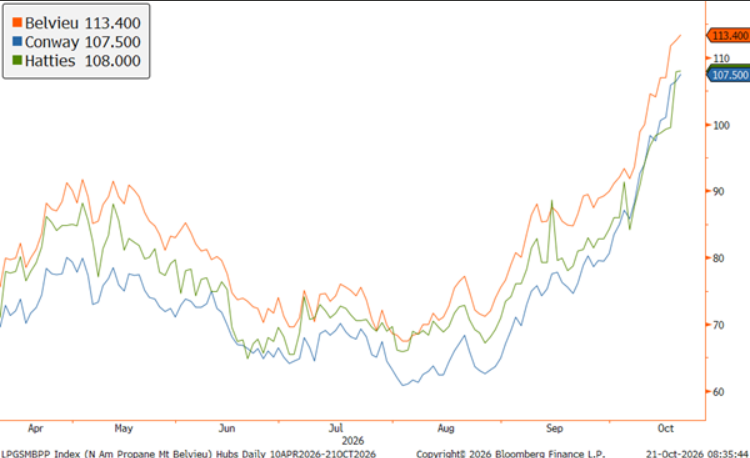
Propane prices posted strong gains last week, supported by robust international demand. Conway recorded the largest increase, followed by Mont Belvieu, with both markets seeing prices climb 5 cents on Friday alone.
Propane buyers in both domestic and international markets are now paying multiyear highs as the U.S. inventory surplus faces the risk of a rapid drawdown. Four of the past five inventory reports have shown declines, despite relatively weak domestic demand. As winter heating demand begins to materialize and exports continue to expand, weekly inventory draws could accelerate significantly, potentially reaching record levels.
Record Diesel Refining Margins Could Reshape U.S. Fuel Production and Put Pressure on Gasoline Prices
The widening gap between diesel and gasoline refining margins is creating a strong financial incentive for U.S. refiners to maximize diesel production wherever operationally possible. With diesel supplies tight, inventories below historical averages, and international buyers competing for available barrels, refiners have a compelling reason to prioritize distillate production. This shift could eventually help ease diesel prices, but it may also create unintended consequences for the U.S. gasoline market.
The crack spread—the difference between the price of a refined petroleum product and the price of crude oil used to produce it—is a key measure of refining profitability. When diesel crack spreads significantly exceed gasoline crack spreads, refiners have a greater financial incentive to produce diesel rather than gasoline, provided their facilities can adjust output without sacrificing overall profitability.
This incentive is particularly important in the current market, where diesel supply remains constrained by low inventories, global trade disruptions, and strong export demand. Refineries are operating at high utilization rates, leaving limited spare capacity to increase total production. As a result, refiners may look to optimize their existing operations to capture the stronger diesel margins.
Increasing diesel production could help alleviate the current supply shortage. If refiners produce more distillate and inventories begin to rebuild, the additional supply could ease wholesale diesel prices and narrow the diesel crack spread. Over time, lower refining margins could reduce the incentive to prioritize diesel over gasoline, allowing production patterns to become more balanced.
However, this process is not automatic. Additional diesel production must exceed the combined demand from domestic consumers and export markets by enough to meaningfully rebuild inventories. If international buyers continue absorbing additional U.S. supplies, or if seasonal demand rises, the effect on domestic prices could be limited. High crack spreads may therefore persist even as refiners increase output.
Refiners also cannot simply stop producing gasoline and redirect all that capacity toward diesel. Refineries manufacture multiple products simultaneously, and the amount of gasoline, diesel, and jet fuel produced depends on refinery configuration, crude oil quality, and operating conditions. Although refiners can adjust their product yields to some extent, their ability to significantly change the production mix is limited.
That creates a potential challenge for the gasoline market. If refiners increase distillate production at the expense of gasoline output, gasoline supplies could tighten, particularly if consumer demand remains steady. Lower production could lead to inventory draws, increased reliance on imports, and higher wholesale gasoline prices.
The impact will depend on the extent to which refiners can adjust their output and whether alternative supplies are available. The United States can import additional gasoline or reduce exports to help offset a domestic shortfall, but those options depend on international availability, transportation costs, and regional infrastructure constraints.
Importantly, gasoline and diesel markets do not operate independently. Refiners must balance production across multiple products while responding to changing margins, seasonal demand, and regional supply conditions. A market that strongly rewards diesel production can therefore create pressure elsewhere in the refined-products system, even if total refinery output remains relatively stable.
The combination of tight diesel inventories and elevated refining margins also raises the possibility that both fuels could experience supply pressure simultaneously. Diesel inventories may remain constrained despite refiners’ efforts to increase production, while gasoline inventories could weaken if output fails to keep pace with demand. In that scenario, higher diesel margins would not necessarily translate into lower gasoline prices. Instead, both products could remain expensive for different reasons.
For the gasoline market, inventory trends will be particularly important. Consistent gasoline inventory draws alongside elevated diesel refining margins would suggest that competition for refinery output is contributing to tighter gasoline supplies. Conversely, weaker gasoline demand, stronger production, or increased imports could limit the effect.
Ultimately, high diesel crack spreads encourage refiners to maximize distillate production wherever possible. If those efforts lead to sustained inventory builds, diesel prices could gradually ease as physical supply improves and refining margins normalize. However, the relief may be delayed if exports remain strong, seasonal demand increases, or refinery constraints limit additional production. Meanwhile, the shift toward diesel could put upward pressure on gasoline prices if gasoline output falls behind demand.
The key indicator to watch is whether U.S. distillate inventories begin to rebuild consistently while gasoline inventories remain adequately supplied. That would suggest refiners are increasing diesel availability without creating a significant new imbalance in the gasoline market. Until then, the unusually wide gap between diesel and gasoline refining margins presents both an opportunity for refiners and a potential source of continued volatility across U.S. fuel markets.
Inspiration

Disclaimer: The data, information and related graphics (collectively, “Information”) is for general information use only and is compiled from sources believed to be reliable. Dale Petroleum Company does not guarantee its accuracy or completeness, nor does DPC assume any liability for any inaccurate or incomplete information. The Information is not intended to be a research report nor an analysis of a company and it should not be relied upon for making investment decisions. The information is subject to change without notice, is for general information only and is not intended as any offer or solicitation with respect to the purchase or sale of any financial instrument or as personal investment advice.