Market Pulse
According to the U.S. Energy Information Administration (EIA), U.S. commercial crude oil inventories decreased by 8.6 million barrels during the week ending October 9, bringing total inventories to 415.6 million barrels. Despite the significant decline, crude oil stocks remain approximately 3% above the five-year seasonal average.
The EIA’s report followed data released by the American Petroleum Institute (API), which indicated a larger crude oil inventory draw of 11.12 million barrels for the same period.
In the futures market, Brent crude was trading at $105.72 per barrel, down $0.34 (0.32%) on the day, while West Texas Intermediate (WTI) rose to $97.01 per barrel, an increase of $1.92 (2.02%). Both benchmarks remained higher than their levels during the corresponding period one week earlier.
U.S. gasoline inventories increased by 3.5 million barrels, following a 400,000-barrel increase in the previous week. Average daily gasoline production was reported at 9.2 million barrels.
Conversely, distillate inventories, which include diesel and heating oil, declined by 2.5 million barrels, while average daily production decreased to 5.2 million barrels. Distillate inventories are now approximately 12% below the five-year seasonal average, indicating a comparatively tighter supply position in this segment of the petroleum market.
Total U.S. petroleum products supplied, a key indicator of domestic demand, averaged 21.1 million barrels per day over the preceding four weeks, representing a 2% increase year over year. Gasoline demand averaged 8.7 million barrels per day, while distillate demand averaged 4.0 million barrels per day, down approximately 0.2% compared with the same period last year.
Fundamentals
EIA’s Weekly Petroleum Inventory in MM’s BBLS
| Commodity | US Inventory | Change | 5 Yr Ave | CURRENT MARKETS |
|---|---|---|---|---|
| Crude Oil | 415.5 | -8.6 | 425 | WTI Crude: 2.85 |
| Gasoline | 208.2 | 3.5 | 219 | RBOB: -0.0792 |
| Distallates | 102.6 | -2.5 | 118 | Heating Oil: -0.0939 |
| Commodity | US Inventory | Change | Midwest Invent | Change |
|---|---|---|---|---|
| Propane | 106.4 | -1.4 | 25.7 | 0.0 |
Propane
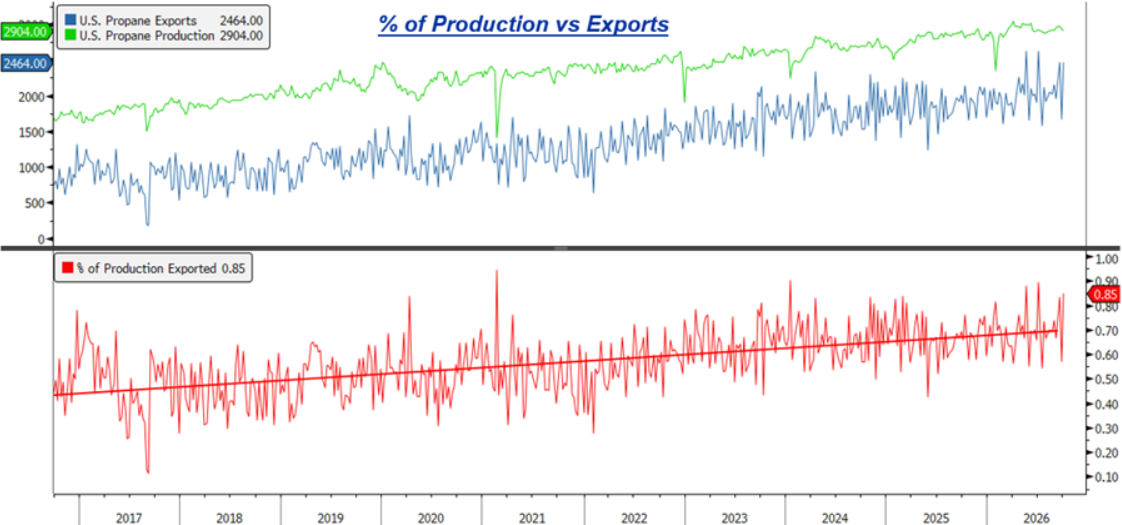
Propane prices ended last week on a strong note, moving closer to seasonal norms. After trading at a discount to crude oil for several months, propane’s value relative to crude has increased to more than 45%.
Strong export demand continues to support propane prices, despite relatively weak domestic heating demand and limited demand for crop drying. As a result, spot prices remain near multi-year or multi-month highs in several markets.
According to the U.S. Energy Information Administration (EIA), U.S. propane exports averaged approximately 2.0 million barrels per day during the first half of the year, representing an 11% increase compared with the same period last year.
Market Outlook: Robust export demand continues to be the primary driver of propane market strength, helping offset subdued seasonal domestic consumption. Export trends, inventory levels and changes in domestic demand will remain key factors influencing propane prices in the near term.
Diesel Prices Could Remain Elevated Well Into 2027, Even if the Iran and Russia–Ukraine Wars End
Even if the Iran and Russia–Ukraine wars ended today, U.S. diesel prices could remain elevated for an extended period. While peace could reduce geopolitical uncertainty and improve oil supply expectations, restoring production, refining and distribution would take considerably longer.
Diesel prices depend on more than crude oil costs. Refinery capacity, fuel inventories, transportation infrastructure, international trade and seasonal demand all influence prices at the pump. The U.S. Energy Information Administration (EIA) has projected an average retail diesel price of approximately $5.19 per gallon for 2026 and $4.49 per gallon for 2027. Although this suggests lower prices next year, it does not guarantee a quick return to pre-conflict levels.
Financial markets may react immediately to a peace agreement, but recovering the physical supply chain is more complicated. Shipping routes may reopen relatively quickly, while damaged refineries, reduced production and logistical bottlenecks could take months to resolve. Even after production improves, refined products must reach importing markets and depleted inventories must be replenished. Consequently, lower crude oil prices would not necessarily translate into immediate or equivalent declines in diesel prices.
Refinery constraints and low inventories could further delay the recovery. Refineries cannot always increase diesel production enough to offset supply losses elsewhere, particularly when infrastructure damage, maintenance requirements or competition from other refined products limit output. Meanwhile, refiners and distributors would need to rebuild fuel reserves while continuing to meet current demand. Until supplies return to more comfortable levels, diesel prices could remain high even as crude oil prices decline.
International trade may also take time to normalize. An end to the Russia–Ukraine war would not automatically restore Russian petroleum exports to previous levels, as sanctions, shipping availability, payment arrangements and infrastructure conditions could continue affecting trade. Similarly, Middle Eastern oil shipments may not immediately return to normal following an end to the Iran conflict. Maritime security, insurance costs, export infrastructure and remaining restrictions could prolong regional supply imbalances.
Using $6.29 per gallon as an illustrative starting benchmark, the potential price trajectory would depend on how quickly global supply recovers.
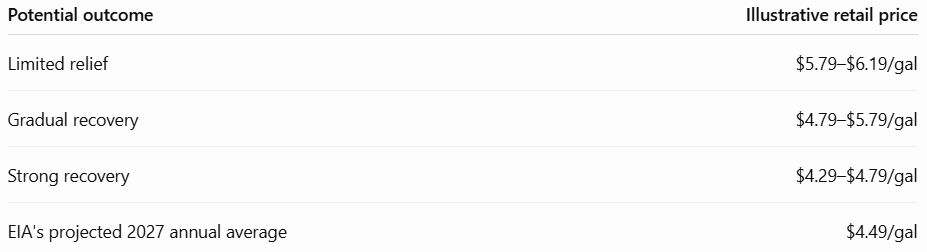
These figures are illustrative scenarios, not official forecasts. The $4.49 figure represents the EIA’s projected 2027 annual average, not a guaranteed year-end price. Actual prices could remain higher if refinery capacity, exports or inventories recover more slowly than expected.
If both conflicts ended and supply chains recovered smoothly, diesel prices could begin declining within weeks. However, restoring refinery output, rebuilding inventories and normalizing international trade could take six to twelve months or longer. Persistent refinery constraints, strong international demand, trade restrictions and seasonal consumption could slow the decline or cause temporary price increases. As a result, diesel prices could remain elevated through much of 2027, even if the conflicts end well before then.
An end to the Iran and Russia–Ukraine wars would remove significant sources of geopolitical risk, but it would not immediately resolve the supply constraints affecting diesel markets. Refinery limitations, depleted inventories and disrupted trade could keep prices elevated for months. For U.S. diesel consumers, peace could mark the beginning of the recovery—not the immediate return of lower prices.
Humor

Disclaimer: The data, information and related graphics (collectively, “Information”) is for general information use only and is compiled from sources believed to be reliable. Dale Petroleum Company does not guarantee its accuracy or completeness, nor does DPC assume any liability for any inaccurate or incomplete information. The Information is not intended to be a research report nor an analysis of a company and it should not be relied upon for making investment decisions. The information is subject to change without notice, is for general information only and is not intended as any offer or solicitation with respect to the purchase or sale of any financial instrument or as personal investment advice.