Market Pulse
U.S. crude inventories declined by 8.0 million barrels last week, driven by strong export activity, while total crude stocks fell by approximately 16 million barrels. Commercial crude inventories now stand at 433.7 million barrels, 3% below the five-year average. The draw exceeded the 6.75 million-barrel decline reported by the API.
Gasoline inventories increased by 3.4 million barrels as demand eased following the Memorial Day holiday, while distillate (diesel) stocks rose 1.5 million barrels. Propane inventories added 2.1 million barrels as exports temporarily slowed; however, export loadings are expected to reach record levels, potentially reflecting the startup of Enterprise’s export expansion project.
Despite the gasoline build, overall U.S. petroleum demand remains healthy. Total products supplied averaged 20.4 million barrels per day over the past four weeks, up 3.0% year-over-year. Gasoline demand averaged 8.8 million barrels per day, while distillate demand increased 1.2% from the same period last year.
Crude prices moved higher following the report, with Brent trading at $98.24 per barrel (+2.3%) and WTI at $95.99 per barrel (+2.3%) in early trading.
Fundamentals
EIA’s Weekly Petroleum Inventory in MM’s BBLS
| Commodity | US Inventory | Change | 5 Yr Ave | CURRENT MARKETS |
|---|---|---|---|---|
| Crude Oil | 433.7 | -8.0 | 454 | WTI Crude: 2.18 |
| Gasoline | 215.0 | 3.4 | 227 | Heating Oil: 0.1611 |
| Distallates | 102.3 | 1.5 | 114 | RBOB: 0.0134 |
| Commodity | US Inventory | Change | Midwest Invent | Change |
|---|---|---|---|---|
| Propane | 83.3 | 2.1 | 18.5 | 0.5 |
Propane
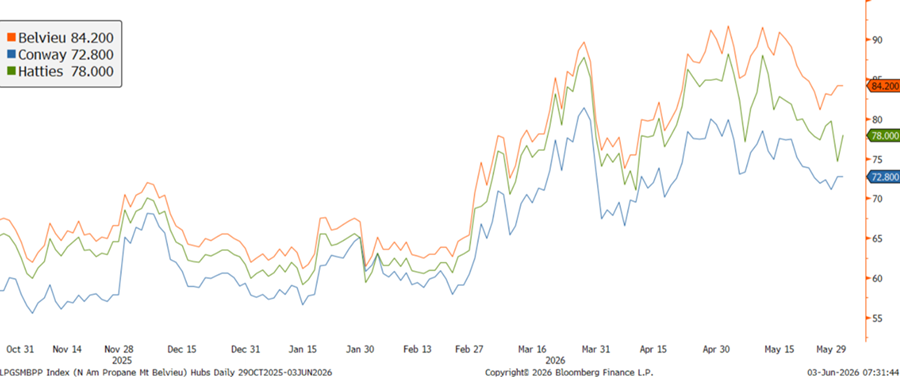
Propane prices traded without a clear directional trend in the previous session. Conway and Mt. Belvieu posted declines, while Hattiesburg recovered a portion of Monday’s losses. Over the past month, Conway has exhibited the lowest level of volatility among the major hubs and has maintained steady buying interest throughout that period.
Total U.S. propane inventories reached a seasonal peak of approximately 70% of capacity this spring but have since declined to 47%. Relative to crude oil, Conway’s valuation fell below 34%, while Mt. Belvieu dropped below 40%.
U.S. LPG export loadings experienced a notable increase in cargo cancellations during June, largely driven by higher freight rates.
Is the World Really Facing an Oil Shortage Because of the Iran War? An Alternative View.
The conflict involving Iran has raised concerns about a global oil shortage, but the reality appears more nuanced than many headlines suggest.
The traditional view is that disruptions to Middle Eastern oil production and shipping reduce global supply, forcing countries to draw down inventories. Under this scenario, oil prices eventually rise until demand falls enough to restore balance.
However, another theory has gained attention: the world may have entered the crisis with larger oil stockpiles than analysts realized. Prior to the conflict, many forecasts predicted a surplus of oil production. Some of that surplus may have accumulated in strategic reserves, commercial storage, and inventories in countries where stock levels are difficult to track, particularly China. If those inventories were larger than expected, they would help explain why prices have not surged as dramatically as some predicted.
At the same time, global oil supply chains have shown considerable flexibility. Refineries can switch suppliers, traders can reroute cargoes, producers can increase output, and countries can release oil from storage. These adjustments often absorb supply shocks long before demand destruction becomes necessary.
This distinction is important. A physical supply disruption does not automatically create an immediate shortage. Markets first rely on inventories, spare production capacity, and logistical adaptations. Only when those options become exhausted do prices typically rise enough to significantly reduce consumption.
The relatively moderate price response so far suggests that a combination of larger-than-expected inventories, softer demand growth, and supply-chain adjustments has helped cushion the market. In other words, the world may not be experiencing a true physical shortage of oil today, even though supplies have become tighter.
The key factor is duration. Inventories and logistical flexibility can buy time, but they are not permanent solutions. If disruptions persist, stockpiles will decline, spare capacity will shrink, and the market will become increasingly dependent on higher prices to balance supply and demand.
For now, the evidence points to a middle ground: there is genuine pressure on global oil supplies, but hidden inventories and adaptable supply chains have likely delayed the kind of severe price spike that typically accompanies a major oil shortage.
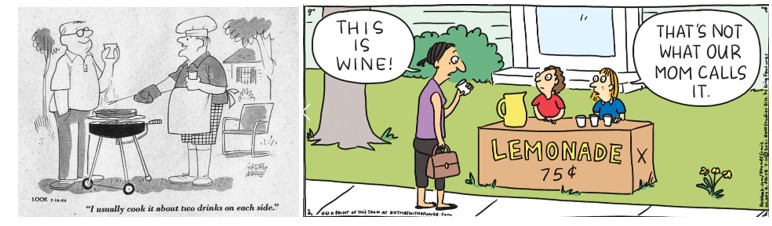
Humor
Disclaimer: The data, information and related graphics (collectively, “Information”) is for general information use only and is compiled from sources believed to be reliable. Dale Petroleum Company does not guarantee its accuracy or completeness, nor does DPC assume any liability for any inaccurate or incomplete information. The Information is not intended to be a research report nor an analysis of a company and it should not be relied upon for making investment decisions. The information is subject to change without notice, is for general information only and is not intended as any offer or solicitation with respect to the purchase or sale of any financial instrument or as personal investment advice.