Market Pulse
U.S. petroleum inventories fell 6.1 Mb on the week, or 15.2 Mb including SPR changes, driven by a 6.1 Mb crude draw that widened the deficit to the five-year seasonal average to 28.7 Mb, or 5.8%. The decline was led by PADD 3 and another 1.1 Mb draw at Cushing, highlighting continued Gulf Coast refinery strength and tightening storage levels despite higher imports, exports, and production. Offsetting the crude draw, gasoline inventories increased by 2.1 Mb, distillates by 3.1 Mb, and propane by 2.6 Mb, largely reflecting softer demand, with implied gasoline demand down 437 Kb/d and distillate demand down 126 Kb/d. While the product builds were bearish relative to expectations, inventories for both gasoline and distillates remain below seasonal norms. Total product supplied declined 170 Kb/d on a four-week average basis but remains 445 Kb/d above the five-year seasonal average, indicating underlying demand remains healthy. Propane inventories also rose more than seasonally expected, even as exports stayed strong at 2.04 Mb/d, up 180 Kb/d from June 2025 levels.
Fundamentals
EIA’s Weekly Petroleum Inventory in MM’s BBLS
| Commodity | US Inventory | Change | 5 Yr Ave | CURRENT MARKETS |
|---|---|---|---|---|
| Crude Oil | 412.1 | -6.1 | 441 | WTI Crude: -2.81 |
| Gasoline | 216.3 | 2.1 | 229 | RBOB: -0.0918 |
| Distallates | 106.1 | 3.1 | 118 | Heating Oil: -0.0013 |
| Commodity | US Inventory | Change | Midwest Invent | Change |
|---|---|---|---|---|
| Propane | 90.0 | 2.6 | 20.7 | 0.5 |
Propane
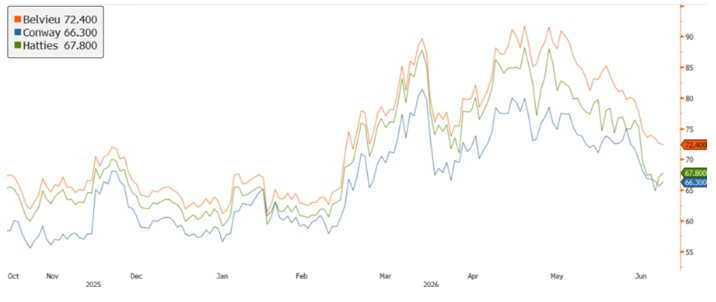
Hub pricing remains well supported at current levels despite continued weakness in WTI crude prices. Following last week’s significant inventory build, another substantial increase is possible as arbitrage economics remain negative for a third consecutive week, and several VLGC cargo cancellations have been reported. It may require an additional large inventory build to alleviate the current strength in the hub cash market.
For the time being, however, lower crude prices are providing little relief to the physical propane market. The EIA is expected to report an average build of 2.4 million barrels in U.S. propane/propylene inventories.
Argument for Why the Bulls Got it Wrong
When geopolitical tensions escalated in the Middle East, oil prices initially spiked on fears that a major supply route could be disrupted. With roughly 20 million barrels per day normally flowing through the Strait of Hormuz, traders quickly priced in the risk of a severe global shortage.
But the worst-case scenario never materialized. Prices fell back sooner than expected, not because the shock was small, but because the global oil system adjusted in multiple ways at once.
The scale of the disruption
At the peak of the crisis, estimates suggest:
- Around 10–14 million barrels per day were affected or delayed at times
- Over several months, this amounted to hundreds of millions of barrels of disrupted flow
However, most of this oil was not permanently lost. It was delayed, rerouted, or replaced through other mechanisms.
Why the oil market stayed balanced
Oil flows didn’t stop—they shifted. Cargoes were rerouted through alternative pipelines, moved on longer shipping routes, or redirected to nearby buyers. Much of the disruption was logistical rather than absolute.
Key producers, especially in the Gulf, were able to increase output modestly. Even small increases of 1–2 mb/d helped stabilize expectations and prevent panic pricing.
Strategic Petroleum Reserves, commercial stockpiles, and floating storage all acted as shock absorbers. These inventories bridged the gap while physical flows adjusted.
Higher prices reduced consumption across transport, industry, and refining. Global demand can fall by 1–3 mb/d within weeks, offsetting a significant share of supply stress.
Rather than dramatically releasing strategic reserves, China and other Asian buyers mainly reduced import urgency and used inventories, preventing demand-side panic from worsening the squeeze.
As traders concluded that extreme scenarios like a prolonged chokepoint closure were unlikely, the geopolitical risk premium collapsed before physical shortages fully developed.
The bottom line
The global oil system didn’t replace every disrupted barrel one-for-one. Instead, it absorbed the shock through a combination of:
- rerouted supply chains
- spare production capacity
- inventory drawdowns
- demand reduction
- and rapid financial repricing
What looked like a massive supply loss in headlines became a manageable imbalance in practice.
The result is a key feature of modern oil markets: they rarely fail from a single shock because multiple adjustment mechanisms activate at the same time.
Humor

Disclaimer: The data, information and related graphics (collectively, “Information”) is for general information use only and is compiled from sources believed to be reliable. Dale Petroleum Company does not guarantee its accuracy or completeness, nor does DPC assume any liability for any inaccurate or incomplete information. The Information is not intended to be a research report nor an analysis of a company and it should not be relied upon for making investment decisions. The information is subject to change without notice, is for general information only and is not intended as any offer or solicitation with respect to the purchase or sale of any financial instrument or as personal investment advice.