Market Pulse
U.S. refinery runs increased by 230,000 bpd to 17.2 million bpd, with utilization rising to 96.7%. Gasoline production increased to 10.1 million bpd, while distillate production declined to 5.2 million bpd. Crude oil imports fell by 754,000 bpd to 5.1 million bpd, with the four-week average down 7.2% year over year. Gasoline and distillate imports averaged 738,000 bpd and 127,000 bpd, respectively. Commercial crude inventories declined by 8.3 million barrels to 418.2 million barrels, remaining 6% below the five-year average. Gasoline inventories fell by 0.9 million barrels, while distillate inventories increased by 1.0 million barrels but remain 13% below seasonal norms. Total commercial petroleum inventories decreased by 7.9 million barrels. Demand remained resilient, with total products supplied averaging 20.6 million bpd over the past four weeks, up 3.3% from a year ago. Distillate demand increased 5.5%, while gasoline demand declined 1.1%.
Fundamentals
EIA’s Weekly Petroleum Inventory in MM’s BBLS
| Commodity | US Inventory | Change | 5 Yr Ave | CURRENT MARKETS |
|---|---|---|---|---|
| Crude Oil | 418.3 | -8.3 | 454 | WTI Crude: 0.76 |
| Gasoline | 214.2 | -0.9 | 227 | RBOB: 0.0051 |
| Distallates | 103.1 | 1.0 | 114 | Heating Oil: 0.0328 |
| Commodity | US Inventory | Change | Midwest Invent | Change |
|---|---|---|---|---|
| Propane | 87.4 | 3.0 | 20.2 | 0.7 |
Propane
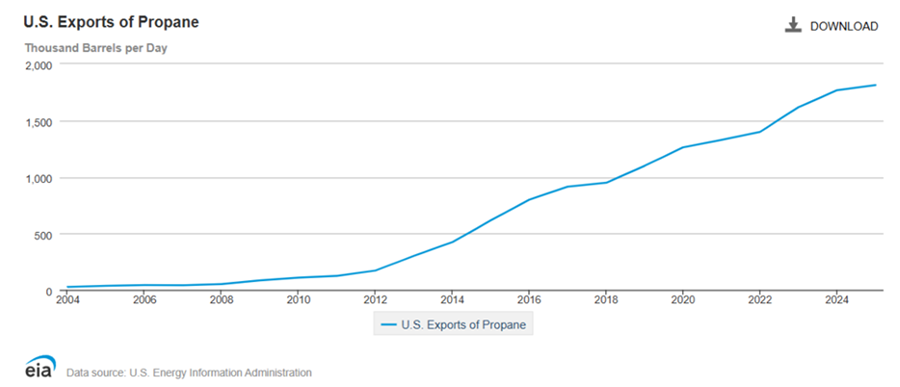
Propane prices declined across all major markets at yesterday’s close, with both Conway and Mt. Belvieu reaching two-month lows. The lower price environment supported Conway spot market activity, driven by increased retail buying. Conway inventories have recovered to within the five-year average range, while the Conway-to-Mt. Belvieu North/South spread has narrowed to approximately -8 cents per gallon.
Inventory builds continue to lag seasonal averages as strong export economics support outbound volumes. Expectations surrounding the reopening of the Strait have pressured Asian spot prices, shifting export demand toward Latin American and African markets.
Could a U.S.-Iran Deal Create an Oil Glut?
Global oil markets may be approaching a turning point as a potential U.S.–Iran agreement could bring Iranian crude back into international trade while policymakers simultaneously consider tighter sanctions on Russian oil exports. The interaction of these two forces will largely determine whether the world moves toward an oil surplus or remains balanced.
A deal with Iran would likely allow a rapid increase in exports and the release of stored crude. Financial markets would react quickly, with prices adjusting on expectations within days or weeks, even before physical supply increases materialize. Actual export growth would likely begin within 1–3 months if sanctions relief is implemented smoothly.
At the same time, global oil supply growth is already expected to outpace demand growth in the coming years. In that environment, additional Iranian barrels could accelerate an emerging surplus rather than create one from scratch.
However, the impact depends heavily on what happens with Russian exports. If new sanctions significantly reduce Russian supply, they could offset much of Iran’s return. If sanctions are less effective and Russian exports continue flowing to alternative buyers, then Iranian oil would add net supply to an already well-supplied market.
A key stabilizing factor is the response from OPEC+. The group could cut production to absorb Iranian barrels and prevent inventories from building too quickly. Without such coordination, the risk of oversupply rises significantly.
How quickly could an oil glut emerge?
A true oil glut—defined as sustained oversupply leading to rising inventories and downward price pressure—could emerge faster than many expect under the right conditions:
- Days to weeks: Prices react immediately to expectations of Iranian supply returning.
- 1-3 months: Initial increases in Iranian exports could begin to show in physical trade flows.
- 3-6 months: The market starts to reveal whether Russian sanctions are materially reducing supply or being bypassed.
- 6-12 months: If Iranian exports rise, Russian exports remain largely intact, and demand grow stays weak, visible inventory builds could signal a developing glut.
If these conditions align unfavorably, signs of an oversupplied market could appear by late 2026 or early 2027. However, if OPEC+ responds with production cuts or sanctions significantly disrupt Russian exports, the surplus could be delayed or much smaller than expected.
Bottom Line
A U.S.–Iran agreement would increase the likelihood of additional oil supply entering global markets and accelerate the risk of oversupply. But whether that translates into a full oil glut depends on the speed of Iranian export recovery, the effectiveness of sanctions on Russia, and whether OPEC+ adjusts production to stabilize the market.
In short, a glut could emerge within months under bearish conditions, but coordinated supply management or strong sanctions enforcement could prevent or delay it.
Humor

Disclaimer: The data, information and related graphics (collectively, “Information”) is for general information use only and is compiled from sources believed to be reliable. Dale Petroleum Company does not guarantee its accuracy or completeness, nor does DPC assume any liability for any inaccurate or incomplete information. The Information is not intended to be a research report nor an analysis of a company and it should not be relied upon for making investment decisions. The information is subject to change without notice, is for general information only and is not intended as any offer or solicitation with respect to the purchase or sale of any financial instrument or as personal investment advice.