Market Pulse
U.S. crude inventories declined sharply during the week ending June 5, falling 15.2 million barrels overall, including a 7.2 million barrel draw in commercial stocks and an 8.0 million barrel reduction in the Strategic Petroleum Reserve (SPR). The decline was driven by strong refinery runs and lower net imports. Commercial crude inventories now stand at 426.5 million barrels, approximately 5% below the five-year average. The U.S. government has indicated it plans to begin replenishing the SPR later this year.
Gasoline inventories increased modestly by 200,000 barrels, while distillate inventories declined by 200,000 barrels and remain 13% below the five-year average. Propane stocks rose by 1.1 million barrels. Demand remained healthy, with total products supplied averaging 20.6 million barrels per day over the past four weeks, up 3.5% year-over-year.
Crude prices moved higher following the report, with Brent rising to $92.82 per barrel (+1.5%) and WTI reaching $89.81 per barrel (+1.8%).
Fundamentals
EIA’s Weekly Petroleum Inventory in MM’s BBLS
| Commodity | US Inventory | Change | 5 Yr Ave | CURRENT MARKETS |
|---|---|---|---|---|
| Crude Oil | 426.5 | -7.2 | 454 | WTI Crude: 1.29 |
| Gasoline | 215.1 | 0.2 | 227 | RBOB: 0.0706 |
| Distallates | 102.1 | -0.2 | 114 | Heating Oil: 0.0424 |
| Commodity | US Inventory | Change | Midwest Invent | Change |
|---|---|---|---|---|
| Propane | 84.5 | 1.1 | 19.5 | 0.7 |
Propane
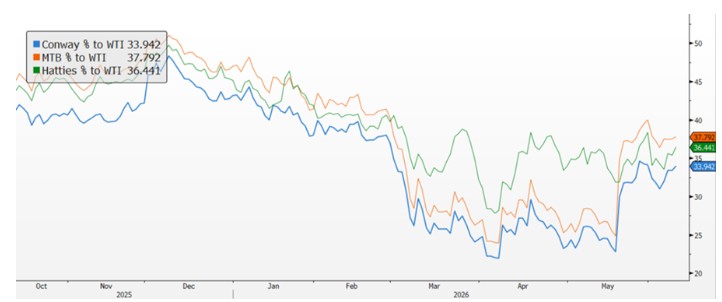
Propane prices declined Tuesday in line with broader weakness across the energy complex. However, hub pricing continues to find support near the low-$0.70s/gal at Conway and the low-$0.80s/gal at Mont Belvieu, as retailers view these levels as attractive buying opportunities ahead of winter heating demand.
The U.S. Energy Information Administration (EIA) is expected to report a 2.26 million-barrel increase in U.S. propane/propylene inventories on Wednesday, according to the average estimate from an OPIS survey of market participants. Survey responses collected Tuesday projected inventory builds ranging from 400,000 barrels to 3.2 million barrels.
U.S. Strategic Petroleum Reserve and Oil Market Tightness in 2026
The U.S. Strategic Petroleum Reserve (SPR) is currently well below its historical peak. It has a maximum capacity of about 714 million barrels and reached roughly 727 million barrels in 2010. As of mid-2026, it holds about 357 million barrels—around half full. That is higher than the post-2022–2023 lows, but still low compared with long-term historical levels.
Even at reduced levels, the SPR still provides a significant energy-security buffer. Recent inventories around 400+ million barrels have been estimated to cover roughly 100+ days of net crude import protection. However, its relative importance is smaller today because the U.S. produces large volumes of oil domestically and depends less on imports than in past decades.
At the same time, U.S. crude oil exports are very high, recently averaging about 5–6 million barrels per day. With total production around 13–14 million barrels per day, a large share of U.S. crude now leaves the domestic system rather than staying in storage or being refined locally.
If SPR releases stop while exports remain strong, the U.S. oil market tends to tighten. Commercial crude inventories run lower, the system becomes more sensitive to supply shocks, price volatility increases, and domestic refiners face more competition for barrels. This happens because the SPR is no longer adding supplemental supply, while exports continue removing crude from the domestic balance.
Overall, the SPR is smaller than in past decades, and high export levels are tightening the U.S. crude balance. Together, these factors reduce inventory buffers and make the market more responsive to disruptions, even though U.S. production remains high.
Humor

Disclaimer: The data, information and related graphics (collectively, “Information”) is for general information use only and is compiled from sources believed to be reliable. Dale Petroleum Company does not guarantee its accuracy or completeness, nor does DPC assume any liability for any inaccurate or incomplete information. The Information is not intended to be a research report nor an analysis of a company and it should not be relied upon for making investment decisions. The information is subject to change without notice, is for general information only and is not intended as any offer or solicitation with respect to the purchase or sale of any financial instrument or as personal investment advice.