Market Pulse
U.S. commercial crude oil inventories fell by 7.2 million barrels, 10.96 with the SPR, during the week ending July 24, according to the U.S. Energy Information Administration (EIA), reducing stockpiles to 404.5 million barrels, approximately 7% below the five-year seasonal average. The draw exceeded the American Petroleum Institute’s estimate of a 3.296 million-barrel decline released a day earlier.
Crude prices rallied following U.S. and Saudi airstrikes against Iran-aligned militias in Iraq. By 9:18 a.m. EDT, Brent crude rose 7.06% to $90.03 per barrel, while WTI gained 6.95% to $84.77 per barrel.
The EIA also reported modest increases in gasoline and distillate inventories, with gasoline production averaging 9.9 million barrels per day and distillate production reaching 5.4 million barrels per day. Despite the increase, distillate inventories remain 9% below the five-year average.
Over the past four weeks, total U.S. petroleum demand averaged 20.3 million barrels per day, down 2.3% year over year. Gasoline demand averaged 8.9 million barrels per day, while distillate demand increased 4.7% year over year to 3.7 million barrels per day.
Fundamentals
EIA’s Weekly Petroleum Inventory in MM’s BBLS
| Commodity | US Inventory | Change | 5 Yr Ave | CURRENT MARKETS |
|---|---|---|---|---|
| Crude Oil | 404.5 | -7.2 | 435 | WTI Crude: 5.98 |
| Gasoline | 211.3 | 0.0 | 228 | RBOB: 0.0577 |
| Distallates | 110.6 | 1.1 | 121 | Heating Oil: 0.2099 |
| Commodity | US Inventory | Change | Midwest Invent | Change |
|---|---|---|---|---|
| Propane | 102.3 | 2.5 | 24.0 | 0.5 |
Propane
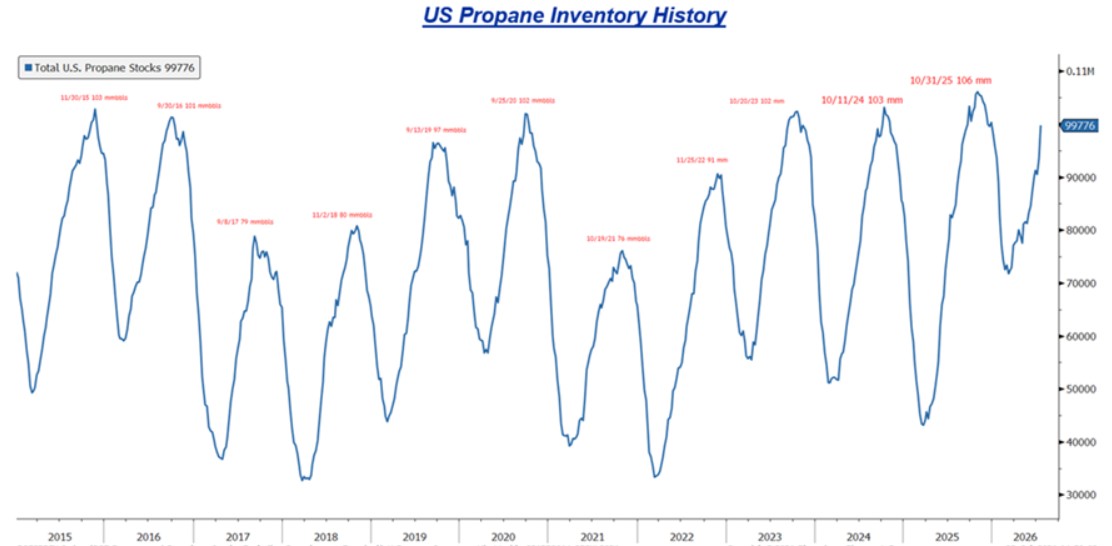
Propane hubs declined alongside other refined products at the close of last week. Trading activity remained relatively light throughout the week, despite crude oil prices increasing by more than $10 per barrel. As a result, propane’s value relative to crude strengthened to approximately 33% in Conway and 35.5% in Mt. Belvieu.
The U.S. propane market continues to hold a relatively flat price position following the 6-million-barrel inventory build reported in last week’s EIA data. Meanwhile, the ongoing conflict and the effective closure of the Strait of Hormuz have disrupted approximately 30% of global LPG trade. With U.S. propane inventories approaching 100 million barrels, any increase in Middle Eastern LPG supply would likely place significant downward pressure on propane prices.
Are Current Oil Prices Reflective of the Physical Market?
Oil price movements since the start of March have sparked considerable discussion across energy markets. Despite significant disruptions to Middle Eastern oil and LPG supplies, crude futures have remained surprisingly resilient, leaving many market participants questioning why prices have not risen more sharply.
The prevailing explanation appears to be market confidence in the industry’s ability to adapt. Similar to 2022, when Russian crude exports continued flowing despite Western sanctions, traders have largely assumed that alternative export routes and logistical adjustments will offset supply disruptions. Saudi Arabia has redirected crude exports through its Red Sea port at Yanbu, while the UAE has also rerouted shipments to maintain export volumes.
While these adjustments have helped limit the impact on crude futures, the physical market tells a different story. The effective closure of the Strait of Hormuz and continued attacks on regional energy infrastructure have disrupted approximately 30% of global LPG trade and constrained crude and refined product movements. As a result, inventories are being drawn down, refining margins have strengthened, and supplies of gasoline, diesel, and jet fuel continue to tighten.
These physical market indicators suggest underlying supply conditions are considerably tighter than futures prices imply. Although optimism surrounding potential de-escalation has kept Brent and WTI crude prices below levels many analysts anticipated, there has been little concrete evidence of a lasting resolution to regional tensions. Instead, current pricing appears to reflect expectations that the market will continue adapting rather than the realities of ongoing supply constraints.
For the propane market, the implications are mixed. Continued disruptions to Middle Eastern LPG exports provide underlying support for global propane values, particularly if physical supply constraints persist. However, the U.S. market remains well supplied, with inventories approaching 100 million barrels. Should Middle Eastern exports recover as logistics improve or geopolitical tensions ease, additional global supply could place downward pressure on propane prices despite current physical market tightness.
Going forward, inventory trends and physical product availability will likely provide a more reliable indication of market direction than crude futures alone. Market participants should continue monitoring global supply flows closely, as changes in physical fundamentals are expected to have a greater influence on propane pricing than sentiment reflected in the futures market.
Humor

Disclaimer: The data, information and related graphics (collectively, “Information”) is for general information use only and is compiled from sources believed to be reliable. Dale Petroleum Company does not guarantee its accuracy or completeness, nor does DPC assume any liability for any inaccurate or incomplete information. The Information is not intended to be a research report nor an analysis of a company and it should not be relied upon for making investment decisions. The information is subject to change without notice, is for general information only and is not intended as any offer or solicitation with respect to the purchase or sale of any financial instrument or as personal investment advice.