Market Pulse
U.S. crude oil inventories fell by 1.7 million barrels during the week ending July 10, according to data released Wednesday by the U.S. Energy Information Administration (EIA). Commercial crude stockpiles now total 409.7 million barrels, approximately 6% below the five-year seasonal average.
The EIA report follows the American Petroleum Institute’s (API) estimate of a smaller 564,000-barrel crude draw released a day earlier.
Despite escalating tensions between the United States and Iran, crude futures traded lower Wednesday morning. As of 10:45 a.m. EDT, Brent crude was down $0.65 (0.77%) at $84.08 per barrel, while West Texas Intermediate (WTI) slipped $0.21 (0.26%) to $79.13 per barrel.
Gasoline inventories declined by 1.5 million barrels, following a 1.9 million-barrel draw the previous week, as average gasoline production eased to 9.6 million barrels per day. Distillate inventories rose by 4.6 million barrels, with production increasing to 5.3 million barrels per day, though stockpiles remain 11% below the five-year average.
Total products supplied, a proxy for U.S. oil demand, averaged 20.3 million barrels per day over the past four weeks, up 0.3% from a year earlier. Gasoline demand averaged 8.9 million barrels per day, while distillate demand averaged 3.7 million barrels per day, down 2.1% year over year.
Fundamentals
EIA’s Weekly Petroleum Inventory in MM’s BBLS
| Commodity | US Inventory | Change | 5 Yr Ave | CURRENT MARKETS |
|---|---|---|---|---|
| Crude Oil | 409.7 | -1.7 | 441 | WTI Crude: 5.61 |
| Gasoline | 210.5 | -1.5 | 229 | RBOB: 0.1955 |
| Distallates | 108.2 | 4.6 | 118 | Heating Oil: 0.4635 |
| Commodity | US Inventory | Change | Midwest Invent | Change |
|---|---|---|---|---|
| Propane | 93.5 | 3.0 | 22.9 | 0.9 |
Propane
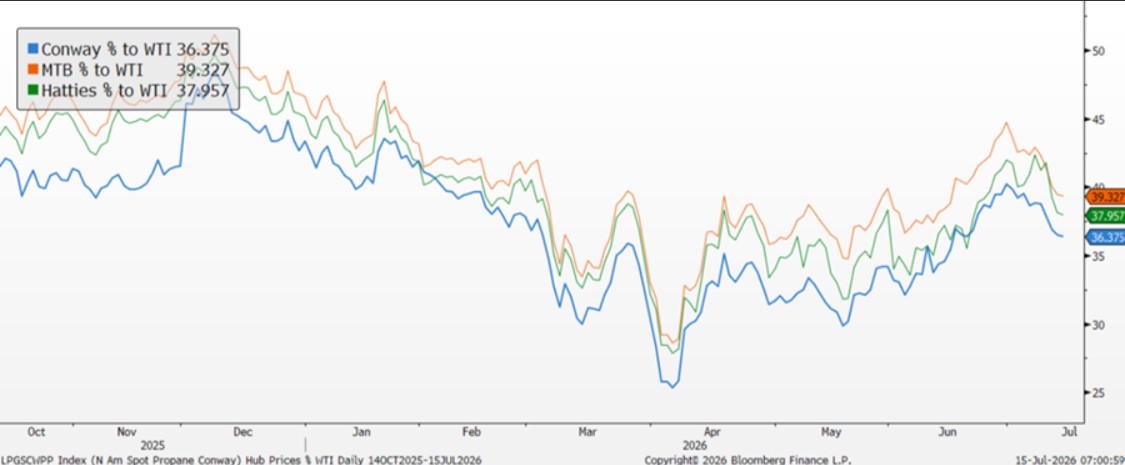
Propane hubs continued to experience volatility this week, extending the price swings seen in the prior week. Prices strengthened through the middle of the week but gave back those gains by week’s end.
Trading began on a strong note Monday, with prices rising by just over $0.04 per gallon. The increase was driven by last week’s inventory draw, elevated export volumes, and ongoing supply disruptions. However, the rally was short-lived, as propane hubs moved lower on Tuesday despite strength in the broader energy complex.
Propane has also continued to lose relative value compared with crude oil as crude prices have advanced. Current relative values are approximately 8% and 6% below their recent highs, depending on the trading hub.
Despite recent price volatility, the outlook for U.S. LPG exports remains constructive, supported by sustained strong demand from Asian buyers.
Refining Margins
Oil refiners are enjoying one of their strongest profit environments in years. While crude prices have fallen back to pre-conflict levels following the reopening of the Strait of Hormuz, gasoline, diesel, and jet fuel prices remain elevated. The result is exceptionally strong refining margins, creating an unexpected windfall for refiners.
The U.S. benchmark 3-2-1 crack spread recently surpassed $60 per barrel, a record high, with similar strength emerging in Europe and Asia. Refiners are benefiting as crude feedstock costs have declined far faster than refined product prices.
The shift began after the U.S. and Iran reached a ceasefire in mid-June. During the Strait of Hormuz closure, hundreds of millions of barrels accumulated in storage and aboard tankers. Once shipping resumed, Middle Eastern exports surged from less than 8 million barrels per day (bpd) in May to more than 12 million bpd in June, according to Kpler, with July volumes expected to increase further as producers release stored crude and restart idle production.
That supply surge has pushed Brent crude back to roughly $70 per barrel, near pre-war levels and about $50 below its conflict peak. Physical cargoes have weakened further as Gulf producers compete aggressively for market share.
Refined fuels, however, remain constrained. Months of refinery disruptions, shipping bottlenecks, and emergency exports depleted global gasoline and diesel inventories, which take considerably longer to rebuild than crude supplies.
In the U.S., gasoline inventories entered the summer driving season at their lowest seasonal level in more than a decade after refiners boosted exports during the Hormuz disruption. Gasoline crack spreads have climbed above $56 per barrel, approaching levels last seen during the 2022 energy crisis.
Diesel markets face even greater pressure as Russian refining capacity continues to decline. Ukrainian strikes have repeatedly targeted refineries, storage terminals, fuel trains, tankers, and export infrastructure, reducing Russian crude-processing rates to their lowest level in more than two decades, according to Energy Aspects. Moscow has responded by restricting fuel exports as domestic shortages worsen, tightening global diesel supplies—particularly in Europe, which previously relied heavily on Russian exports.
The divergence between crude and refined products reflects two markets moving at different speeds. Crude is adjusting to a temporary supply glut created by the release of stored barrels, while fuel markets continue to recover from depleted inventories and ongoing refinery outages.
History suggests this imbalance will eventually narrow. Sustained refining activity will increase crude demand and absorb excess supply, while Gulf producers are unlikely to maintain steep discounts indefinitely. Fuel prices may also ease as inventories recover, though continued disruptions to Russian and Middle Eastern refining capacity could delay that process.
For now, refiners occupy a rare sweet spot: cheap crude, expensive fuels, and record margins. Such market distortions rarely persist indefinitely.
Humor

Disclaimer: The data, information and related graphics (collectively, “Information”) is for general information use only and is compiled from sources believed to be reliable. Dale Petroleum Company does not guarantee its accuracy or completeness, nor does DPC assume any liability for any inaccurate or incomplete information. The Information is not intended to be a research report nor an analysis of a company and it should not be relied upon for making investment decisions. The information is subject to change without notice, is for general information only and is not intended as any offer or solicitation with respect to the purchase or sale of any financial instrument or as personal investment advice.