Market Pulse
Crude oil inventories in the United States saw an increase of 2.5 million barrels during the week ending July 31, according to new data from the U.S. Energy Information Administration (EIA) released on Wednesday. The increase brings commercial stockpiles to 407 million barrels, according to government data, which are now 6% below the five-year average for this time of year.
The EIA’s data release follows API’s figures that were released a day earlier, which reported that crude oil inventories had risen by 2.69 million barrels in the period.
Crude futures crept up in early morning trade after a major selloff Tuesday inspired by renewed talks of a potential peace deal. At 9:51 a.m. in New York, Brent futures were trading at $79.62 per barrel, up $0.26 (+0.33%) on the day but down roughly $10 per barrel from this same time last week. WTI was trading slightly down on the day, by $0.42 per barrel (-0.55%) on Wednesday morning at $75.35, down $9 per barrel since this time last week.
For total motor gasoline, the EIA reported that inventories fell 1.6 million barrels, after increasing slightly in the week prior. The most recent figures showed that average daily gasoline production decreased to 9.6 million barrels. For middle distillates, inventories decreased by 3.5 million barrels, with production decreasing to an average of 5.2 million barrels daily. Distillate inventories are now 12% below the five-year average.
Total products supplied, a proxy for U.S. oil demand, averaged 20.4 million barrels per day over the last four weeks, down 0.9% compared to the same period last year. Gasoline demand averaged 9.0 million barrels per day over the last four weeks, while the distillate four-week average supplied averaged 3.6 million barrels,up 1.8% year over year.
Fundamentals
EIA’s Weekly Petroleum Inventory in MM’s BBLS
| Commodity | US Inventory | Change | 5 Yr Ave | CURRENT MARKETS |
|---|---|---|---|---|
| Crude Oil | 407.0 | 2.5 | 435 | WTI Crude: -0.53 |
| Gasoline | 209.7 | -1.6 | 228 | RBOB: 0.0099 |
| Distallates | 107.2 | -3.5 | 121 | Heating Oil: 0.0530 |
| Commodity | US Inventory | Change | Midwest Invent | Change |
|---|---|---|---|---|
| Propane | 103.1 | 0.8 | 24.6 | 0.6 |
Propane
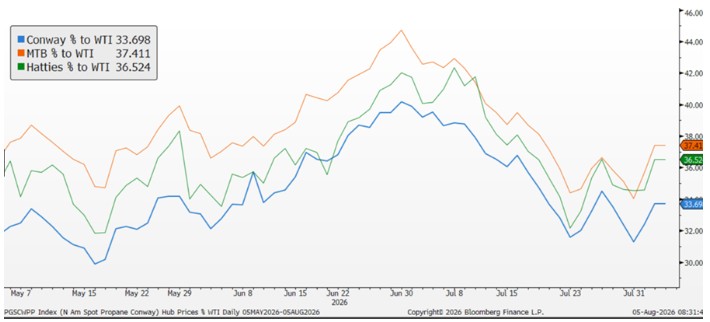
Propane prices continued to trend lower last week and have extended those losses into this week as inventories continue to build. Conway prices declined 1.75 cents per gallon, while Mt. Belvieu fell 3.0 cents per gallon. Since last week’s inventory report, propane prices have retreated by nearly 6 cents per gallon.
Inventory levels remain on pace to challenge the all-time high of 106 million barrels set in 2015, reinforcing the market’s bearish outlook. While there has been modest support for winter contracts driven by retail hedging activity, the abundant supply of natural gas liquids (NGLs) is expected to limit any meaningful upside in prices.
Deal or No Deal?
Oil markets are awaiting a decision from Iran’s supreme leader after Iranian and Omani negotiators reportedly finalized a draft agreement that could reopen the Strait of Hormuz, the primary export route for Persian Gulf oil and liquefied natural gas (LNG).
Two regional officials familiar with the negotiations told the Associated Press on Wednesday that the draft agreement had been completed, just hours after President Donald Trump said an announcement could come as early as Wednesday or Thursday.
Under the proposed interim arrangement, ships entering the Persian Gulf would transit through waters controlled by Iran, while outbound vessels would follow a route administered by Oman. The agreement would revive elements of the U.S.-Iran memorandum reached in June, which unraveled after renewed attacks on commercial shipping.
Transit fees remain the principal sticking point in the negotiations. Reuters reported that Tehran is seeking fees equivalent to 5% to 7% of a vessel’s cargo value, while Oman has proposed a 3% charge. The Trump administration has opposed any agreement requiring vessels to pay Iran for passage through a waterway that functioned as an open international shipping route prior to the outbreak of the conflict.
The diplomatic effort comes as shipping activity through the Strait of Hormuz remains well below normal levels. According to Kpler, just eight vessels transited the strait on Tuesday, compared with an average of approximately 130 to 140 daily crossings before the U.S.-Israeli conflict with Iran began on February 28.
Oil prices initially declined on expectations that an agreement could restore Gulf energy exports. However, Brent crude later recovered to around $80 per barrel as continued attacks on regional shipping underscored ongoing security risks.
On Wednesday, the Houthis claimed responsibility for firing ballistic missiles at the Saudi tanker Wafa near the Red Sea port of Yanbu. Separately, an Indian-flagged vessel sank off the coast of Yemen on Tuesday after being struck by an explosive-laden boat, while another cargo ship reported coming under attack near Oman’s Al Khasab port in the Strait of Hormuz.
Humor

Disclaimer: The data, information and related graphics (collectively, “Information”) is for general information use only and is compiled from sources believed to be reliable. Dale Petroleum Company does not guarantee its accuracy or completeness, nor does DPC assume any liability for any inaccurate or incomplete information. The Information is not intended to be a research report nor an analysis of a company and it should not be relied upon for making investment decisions. The information is subject to change without notice, is for general information only and is not intended as any offer or solicitation with respect to the purchase or sale of any financial instrument or as personal investment advice.