Market Pulse
U.S. crude oil inventories increased by 4.4 million barrels on a commercial basis during the week, although a 5.3 million-barrel release from the Strategic Petroleum Reserve (SPR) resulted in a modest net draw. Crude exports also moved higher.
With the Strait of Hormuz reopening, the surge of vessels arriving in the U.S. to load crude has subsided, but activity is expected to pick up again. Commercial crude inventories now stand at approximately 428.8 million barrels, essentially in line with the five-year average for this time of year.
Gasoline inventories increased modestly by 700,000 barrels, supported by strong refinery utilization. Despite elevated gasoline prices, demand has remained resilient. Year-to-date average gasoline consumption is 8.776 million barrels per day, compared with 8.780 million barrels per day during the same period last year.
Distillate inventories declined by 1.5 million barrels and remain at very low levels—approximately 13% below the five-year average. Strong export demand, combined with declining production, suggests inventories could tighten further in the coming weeks.
Propane inventories posted a respectable 2.0 million-barrel build, bringing total stocks to approximately 107 million barrels.
Overall, the latest data point to a relatively balanced crude market but increasingly tight middle-distillate inventories. Strong refinery runs continue to support gasoline and distillate production, while resilient demand and elevated exports are limiting inventory builds, particularly for diesel.
Fundamentals
EIA’s Weekly Petroleum Inventory in MM’s BBLS
| Commodity | US Inventory | Change | 5 Yr Ave | CURRENT MARKETS |
|---|---|---|---|---|
| Crude Oil | 428.8 | 4.4 | 432 | WTI Crude: 1.78 |
| Gasoline | 209.4 | 0.7 | 222 | RBOB: -0.0227 |
| Distallates | 105.6 | -1.5 | 119 | Heating Oil: 0.0276 |
| Commodity | US Inventory | Change | Midwest Invent | Change |
|---|---|---|---|---|
| Propane | 107.0 | 0.7 | 26.2 | 1.1 |
Propane
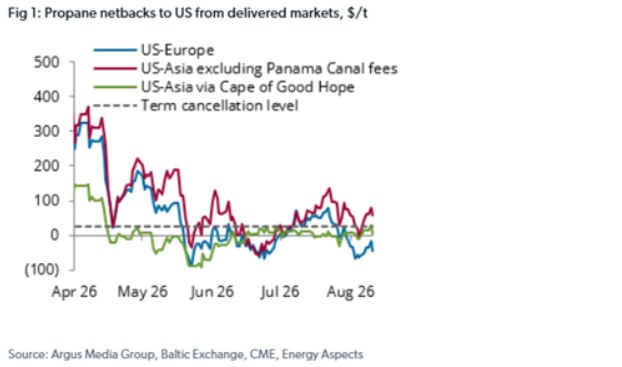
Propane opened higher this week, following gains in crude oil prices. The North/South spread widened slightly and is currently near -8 cents.
Exports to Asia remain active, supported by continued disruption in the Strait of Hormuz and increasingly restrictive conditions in the Panama Canal. Both factors are supporting higher delivered propane values in Asia and helping maintain export demand.
Domestically, propane inventories remain nearly 20% above year-ago levels and are approaching record highs. With inventories already above 100 million barrels, any additional builds are likely to place further downward pressure on propane prices, which are already trading at historically low levels relative to crude oil.
Overall, the market remains well supplied, while strong export demand is providing some support. However, the elevated inventory position remains a significant bearish factor for propane pricing.
The Iran War: More Than a U.S.–Iran Conflict
The war between the United States and Iran is, on the surface, a direct conflict between two longtime adversaries. But beneath it lies a larger geopolitical struggle involving China.
It would be an oversimplification to call the war a U.S.–China proxy war. Iran is not simply China’s proxy, and Tehran has its own reasons for confronting Washington. However, China’s growing economic and strategic relationship with Iran makes Beijing an important part of the larger picture.
China is one of Iran’s most important economic lifelines, particularly through purchases of Iranian oil. That helps Tehran withstand U.S. sanctions and makes it harder for Washington to isolate Iran. In response, the United States has increasingly targeted Chinese companies and networks accused of helping Iran evade sanctions.
China also has a major interest in the Persian Gulf. The region is critical to global energy supplies and to China’s own economy. Beijing therefore benefits from maintaining a strong relationship with Iran, but it does not necessarily want a prolonged war that disrupts oil shipments and destabilizes the region.
There is another strategic dimension: every major U.S. military commitment in the Middle East can divert American resources and attention away from China and the Indo-Pacific. A prolonged conflict could therefore benefit Beijing by stretching U.S. military power, straining American alliances, and weakening confidence in Washington’s leadership.
That does not mean China wants Iran to defeat the United States. China’s ideal outcome may be more subtle: Iran survives, the United States becomes increasingly consumed by the conflict, and China emerges with greater economic and diplomatic influence.
Ultimately, the conflict is best understood as several overlapping struggles: the U.S.–Iran confrontation, the Iran–Israel conflict, the fight over Persian Gulf security, and the broader competition between the United States and China.
So the answer is neither simply “U.S. versus Iran” nor “U.S. versus China.”
The United States and Iran are fighting the immediate war, but the strategic consequences are part of a much larger contest between Washington and Beijing over who will shape the Middle East—and, ultimately, the global order.
Humor

Disclaimer: The data, information and related graphics (collectively, “Information”) is for general information use only and is compiled from sources believed to be reliable. Dale Petroleum Company does not guarantee its accuracy or completeness, nor does DPC assume any liability for any inaccurate or incomplete information. The Information is not intended to be a research report nor an analysis of a company and it should not be relied upon for making investment decisions. The information is subject to change without notice, is for general information only and is not intended as any offer or solicitation with respect to the purchase or sale of any financial instrument or as personal investment advice.