Market Pulse
U.S. crude oil inventories fell by 900,000 barrels for the week ending April 10, according to the U.S. Energy Information Administration (EIA), bringing commercial stockpiles to 463.8 million barrels, about 1% above the five-year seasonal average, despite a prior estimate from the American Petroleum Institute indicating a 6.1 million-barrel increase. Crude prices, which declined earlier in the week, rebounded Wednesday morning, with Brent trading at $96.16 per barrel and WTI at $92.58, reflecting daily gains but a week-over-week decline for WTI. Meanwhile, gasoline inventories dropped sharply by 6.3 million barrels as production rose to 9.8 million barrels per day, while distillate inventories fell by 3.1 million barrels with production averaging 4.9 million barrels per day, leaving distillate stockpiles 6% below the five-year average. Overall U.S. petroleum demand remained strong, with total products supplied averaging 20.6 million barrels per day over the past four weeks, up 5.6% year over year, alongside modest increases in gasoline and distillate demand.
Fundamentals
EIA’s Weekly Petroleum Inventory in MM’s BBLS
| Commodity | US Inventory | Change | 5 Yr Ave | CURRENT MARKETS |
|---|---|---|---|---|
| Crude Oil | 463.8 | -0.9 | 455 | WTI Crude: 0.70 |
| Gasoline | 232.9 | -6.3 | 237 | Heating Oil: 0.1901 |
| Distallates | 111.6 | -3.1 | 121 | RBOB: 0.0464 |
| Commodity | US Inventory | Change | Midwest Invent | Change |
|---|---|---|---|---|
| Propane | 77.9 | 0.3 | 14.7 | -0.2 |
Propane
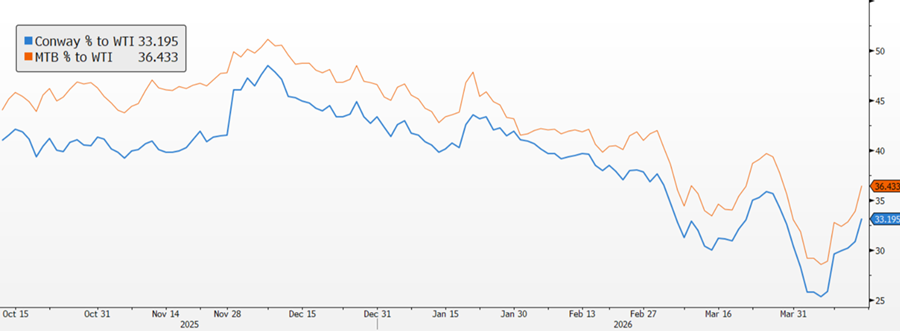
Propane prices declined from recent highs on Tuesday, tracking the broader downturn in crude oil. Despite this pullback, LP prices have strengthened relative to crude, increasing by 4.5% at Conway and 5% at Belvieu over the past two periods.
Overall, inventory levels remain approximately 70% above those of last year and have recently exceeded 3 million barrels per day—an all-time high. Export volumes continue to increase and are expected to rise further, supported by strong netbacks in both Asian and European markets.
What’s the real price of crude?
A significant gap has emerged between physical oil prices and financial market benchmarks. Dated Brent, reflecting near-term physical delivery, has surged to $132.74 per barrel, while front-month Brent futures remain much lower at $99.36. This unprecedented divergence highlights severe disruption and uncertainty in global oil markets.
The primary driver is a tight physical supply, which has pushed spot prices higher and widened the spread with futures. Front-month futures are often disconnected from physical market conditions, particularly for Brent, which settles against an index rather than through physical delivery. By contrast, WTI futures are physically settled, contributing to structural differences between benchmarks.
High volatility is another key factor. Traders are reluctant to take large positions due to the risk of sharp price swings and margin calls, resulting in reduced market participation and amplified price movements. At the same time, futures markets currently reflect a more balanced mix of buyers and sellers, unlike the physical market, where demand significantly exceeds available supply.
Additional dynamics—such as hedging activity by producers and transactions tied to the U.S. Strategic Petroleum Reserve—are also influencing futures pricing. Meanwhile, concerns about market timing and trading behavior have added to uncertainty.
Despite the disconnect, oil producers are unlikely to scale back investment, as they continue to benefit from strong spot prices. Ultimately, for a clearer view of future energy prices, investors should focus more on physical supply conditions, particularly in key regions like the Strait of Hormuz—than on futures market signals alone.
Funny

Disclaimer: The data, information and related graphics (collectively, “Information”) is for general information use only and is compiled from sources believed to be reliable. Dale Petroleum Company does not guarantee its accuracy or completeness, nor does DPC assume any liability for any inaccurate or incomplete information. The Information is not intended to be a research report nor an analysis of a company and it should not be relied upon for making investment decisions. The information is subject to change without notice, is for general information only and is not intended as any offer or solicitation with respect to the purchase or sale of any financial instrument or as personal investment advice.