Market Pulse
U.S. crude oil inventories declined by 900,000 barrels during the week ending October 30, according to data released Wednesday by the U.S. Energy Information Administration (EIA). The drawdown brought commercial crude inventories to 409.8 million barrels, approximately 4% below the five-year average for this time of year.
Total commercial petroleum inventories fell by a more substantial 8.2 million barrels during the reporting period.
The EIA report followed figures released Tuesday by the American Petroleum Institute (API), which showed a much larger crude inventory draw of 5.267 million barrels.
Crude oil futures were trading lower Wednesday morning. At 10:09 a.m. ET, Brent crude was down $2.89 per barrel (-2.79%) to $100.71, approximately $15 per barrel lower than at the same time the previous week. West Texas Intermediate (WTI) was also under pressure, declining $2.79 per barrel (-2.90%) to $93.30, down nearly $9 per barrel compared to the previous Wednesday.
Gasoline inventories declined by 200,000 barrels, following a 3.9-million-barrel increase the previous week. Average daily gasoline production increased to 9.7 million barrels.
Distillate inventories, which include diesel and heating oil, posted a much larger draw of 3.6 million barrels, while average daily production declined to 5.2 million barrels. Distillate inventories now stand 13% below the five-year average, highlighting continued tightness in the middle-distillate market.
On the demand side, total petroleum products supplied, which serves as an indicator of U.S. petroleum consumption, averaged 21.2 million barrels per day over the past four weeks. That represents a 4.2% increase compared to the same period last year.
Gasoline demand averaged 8.6 million barrels per day over the four-week period, while distillate demand averaged 4.2 million barrels per day, an increase of 8.7% year over year.
Fundamentals
EIA’s Weekly Petroleum Inventory in MM’s BBLS
| Commodity | US Inventory | Change | 5 Yr Ave | CURRENT MARKETS |
|---|---|---|---|---|
| Crude Oil | 409.8 | -0.9 | 432 | WTI Crude: 3.47 |
| Gasoline | 209.0 | -0.2 | 220 | RBOB: 0.0305 |
| Distallates | 99.3 | -3.6 | 114 | Heating Oil: 0.0748 |
| Commodity | US Inventory | Change | Midwest Invent | Change |
|---|---|---|---|---|
| Propane | 104.1 | -1.6 | 25.1 | -0.1 |
Propane
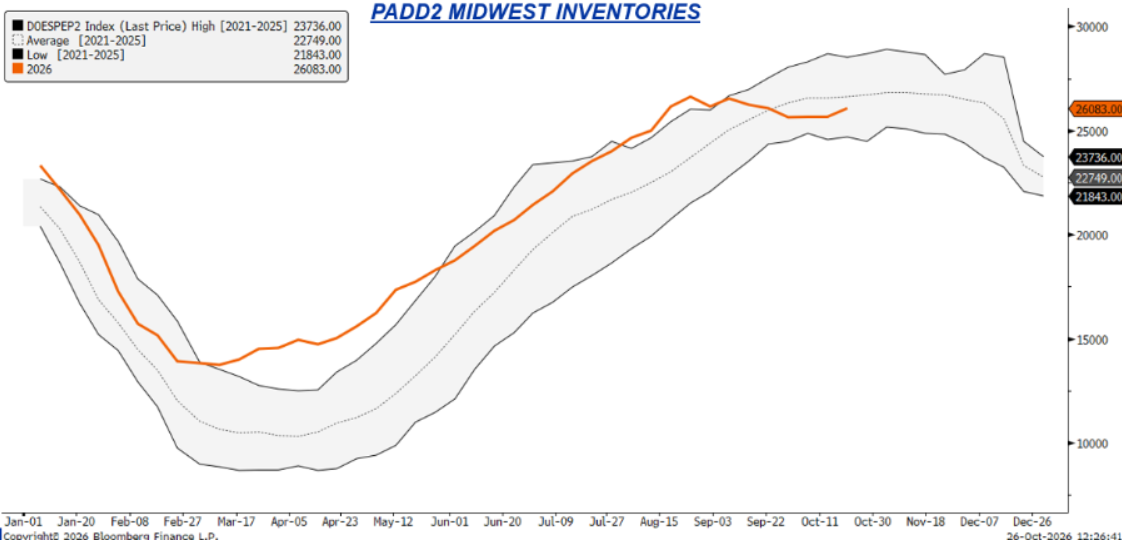
Propane spot prices increased nearly 8 cents on Friday; however, the rally was short-lived as prices reversed direction with the opening of November trading. Most major trading hubs recorded declines ranging from 8 to 10 cents per gallon.
There were no significant changes in the underlying propane market fundamentals. However, the sharp decline in crude oil prices proved too much for propane to overcome, putting downward pressure on spot pricing.
Throughout October, propane prices experienced a strong upward trend, supported by tightening domestic inventories, steady export demand, and broader international market dynamics. Total U.S. propane and propylene inventories fell below 106 million barrels, reaching their lowest level since early August.
Despite the recent pullback in prices, the underlying fundamentals that supported October’s rally remain worth watching, particularly inventory levels and continued export demand.
Crude Oil, Gasoline and Diesel Prices Plunge as Markets Reassess Geopolitical Risk
Crude oil, gasoline and diesel prices experienced a significant selloff Wednesday as energy markets reacted to shifting geopolitical expectations surrounding the war with Iran and the possibility of improved global oil supplies.
The decline was driven largely by a reduction in the geopolitical risk premium that has supported energy prices in recent months. Comments from President Trump indicating there were no immediate plans for additional military strikes against Iran, combined with renewed diplomatic efforts, have led traders to reassess the likelihood of further supply disruptions in the Middle East.
Markets are increasingly considering the possibility that tensions could ease and that crude oil and refined-product exports from the region could gradually recover. Even without a formal peace agreement, the expectation of improved supply availability can be enough to trigger significant selling in futures markets.
The U.S. midterm election results also contributed to the market’s reaction. Democratic gains in Congress have prompted some traders to consider whether the changing political landscape could limit the administration’s ability to pursue an aggressive foreign policy. While this does not necessarily signal an immediate change in U.S. policy toward Iran, it has added another layer of uncertainty to the market’s outlook.
The selloff extended across all three major energy markets. WTI crude fell approximately 8% at one point during Wednesday’s trading, while diesel futures declined roughly 10 cents per gallon and gasoline futures lost nearly 6 cents per gallon in the morning session.
However, the decline in refined-product prices comes despite continued signs of tightness in the domestic fuel market. Recent inventory figures showed U.S. crude inventories declining by approximately 865,000 barrels, gasoline stocks falling by 200,000 barrels and distillate inventories dropping by approximately 3.6 million barrels. Distillate inventories remain roughly 13% below the five-year average, highlighting the continued supply challenges facing the diesel market.
This distinction is important. Today’s price movement is being driven more by expectations of future supply improvements than by any meaningful improvement in current domestic inventories. The possibility of additional Middle Eastern crude and refined-product exports is being priced into the market before those supplies have physically returned.
For the Upper Midwest and Upper Plains, the decline in futures prices does not necessarily mean wholesale diesel prices or local supply conditions will immediately improve. Pipeline constraints, terminal availability, refinery operations and regional allocations can all influence rack pricing independently of broader futures movements.
An important indicator to monitor in the coming days will be the diesel crack spread, which measures the difference between crude oil and refined-product prices. If diesel prices decline less aggressively than crude, it would suggest that the underlying diesel market remains relatively tight despite the broader energy selloff.
Ultimately, Wednesday’s sharp decline appears to represent a significant unwinding of geopolitical risk premiums rather than confirmation that the global diesel supply situation has been resolved. While the possibility of easing tensions and recovering exports could provide additional downward pressure on prices, actual improvements in physical supply and inventories will take time.
For now, energy markets remain highly sensitive to developments in the Middle East. If diplomatic progress continues, prices could face additional pressure. However, any renewed escalation or disruption to global supply routes could quickly reverse the recent decline.
Inspiration

Disclaimer: The data, information and related graphics (collectively, “Information”) is for general information use only and is compiled from sources believed to be reliable. Dale Petroleum Company does not guarantee its accuracy or completeness, nor does DPC assume any liability for any inaccurate or incomplete information. The Information is not intended to be a research report nor an analysis of a company and it should not be relied upon for making investment decisions. The information is subject to change without notice, is for general information only and is not intended as any offer or solicitation with respect to the purchase or sale of any financial instrument or as personal investment advice.