Market Pulse
U.S. crude oil inventories declined by 1.9 million barrels during the week ending October 23, according to data released Wednesday by the U.S. Energy Information Administration (EIA). Commercial crude inventories fell to 410.6 million barrels, approximately 4% below the five-year average for this time of year.
The EIA report followed data released Tuesday by the American Petroleum Institute (API), which showed a larger crude inventory draw of 2.031 million barrels.
Crude oil futures were trading higher Wednesday morning at 10:26 a.m. ET. Brent crude rose $1.73 per barrel, or 1.52%, to $115.61, approximately $7 per barrel higher than at the same time the previous week. West Texas Intermediate (WTI) gained $2.51 per barrel, or 2.51%, to $102.41, an increase of nearly $5 per barrel over the same period.
Gasoline inventories increased by 3.9 million barrels, reversing the previous week’s decline of 3 million barrels. Meanwhile, average daily gasoline production fell to 9.2 million barrels.
Distillate inventories, which include diesel and heating oil, declined by 1.5 million barrels as average daily production decreased to 5.2 million barrels. Distillate stockpiles now stand 10% below the five-year average, highlighting continued tightness in the market.
Total petroleum products supplied, a key indicator of U.S. oil demand, averaged 20.8 million barrels per day over the past four weeks, up 0.2% from the same period last year. Gasoline supplied averaged 8.6 million barrels per day, while distillate supplied averaged 4.0 million barrels per day, down 0.6% year over year.
Fundamentals
EIA’s Weekly Petroleum Inventory in MM’s BBLS
| Commodity | US Inventory | Change | 5 Yr Ave | CURRENT MARKETS |
|---|---|---|---|---|
| Crude Oil | 410.6 | -1.9 | 423 | WTI Crude: 3.47 |
| Gasoline | 209.2 | 3.9 | 220 | RBOB: 0.0305 |
| Distallates | 102.8 | -1.5 | 121 | Heating Oil: 0.0748 |
| Commodity | US Inventory | Change | Midwest Invent | Change |
|---|---|---|---|---|
| Propane | 105.7 | -0.1 | 25.2 | -0.9 |
Propane
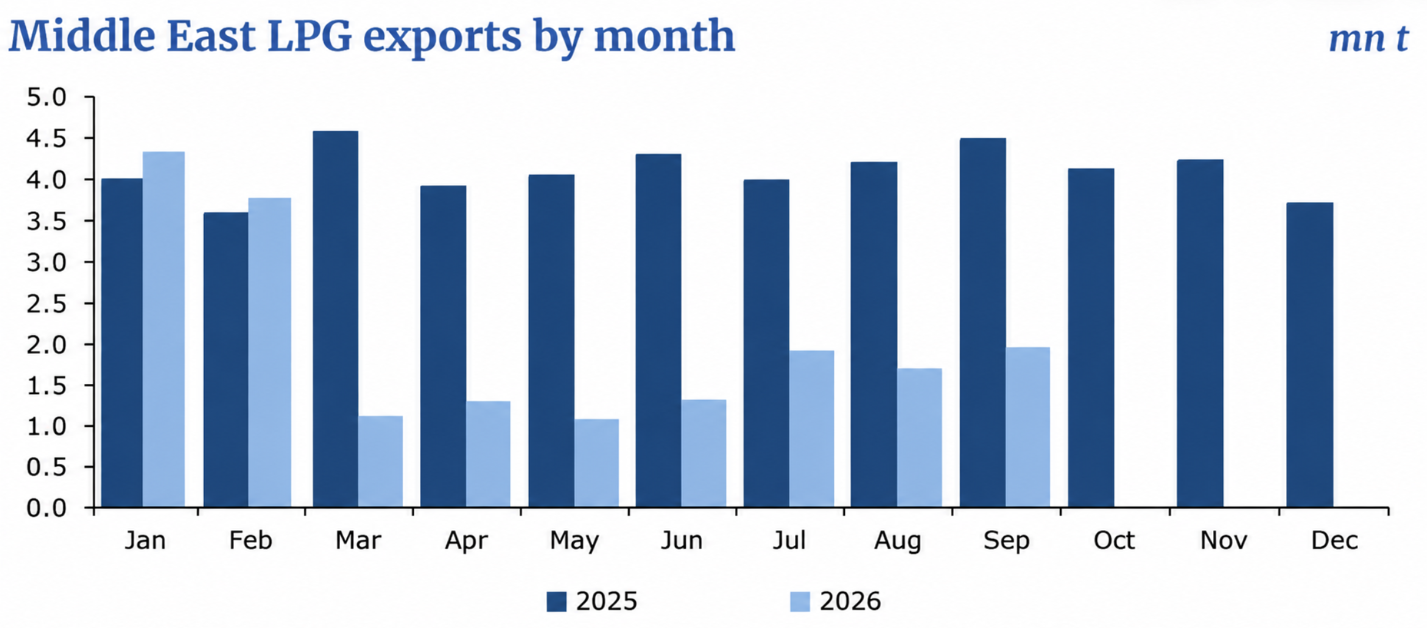
Propane prices continued to track crude oil higher, with Mont Belvieu leading the market as the week came to a close. The primary driver behind the month-long rally has been strong U.S. export demand. India’s purchases of U.S. propane have surged, accounting for 72% of the country’s imports compared with just 6% in 2025. Meanwhile, U.S. exports to China and Southeast Asia have also increased, with their combined share rising from 25% to 33%.
Strong export demand, coupled with domestic consumption, has accelerated inventory drawdowns relative to typical seasonal levels. As a result, international buyers are competing with domestic consumers for available U.S. supply, creating additional upward pressure on wholesale propane prices.
Winter 2026–27 Outlook: Milder Weather Could Ease Fuel Demand, but Diesel and Propane Markets Remain Vulnerable
As the United States heads into the winter of 2026–27, the latest seasonal outlook suggests that much of the Upper Plains and central United States could experience warmer-than-normal temperatures. While this would generally be favorable for energy consumers by reducing heating demand, it does not necessarily mean diesel and propane prices will decline significantly. Tight inventories, strong export demand, agricultural consumption and regional distribution constraints could continue to influence wholesale prices and fuel availability throughout the winter.
The National Oceanic and Atmospheric Administration’s (NOAA) October outlook favors above-normal temperatures across much of the northern United States, including the Midwest and Mississippi Valley, during December, January and February. However, seasonal forecasts do not rule out periods of extreme cold, significant snowfall or prolonged winter storms. Even if temperatures average above normal for the season, individual cold outbreaks could still create substantial increases in fuel demand.
For the energy markets, the distinction between seasonal averages and short-term weather events will be particularly important this winter.
Diesel demand could benefit from a relatively mild winter. Warmer temperatures generally reduce heating-oil consumption in markets where it is used, while potentially limiting weather-related transportation disruptions. However, diesel demand extends well beyond heating. Trucking, agriculture, grain transportation, livestock operations and snow removal will continue to consume substantial volumes of fuel across the Upper Plains and central United States.
More importantly, the current diesel market is being influenced by supply constraints that may not be resolved by milder weather alone. Limited inventories, refinery production, pipeline operations and terminal availability can all affect the amount of fuel reaching regional markets. If these constraints persist, a reduction in seasonal demand may provide only limited relief.
The U.S. Energy Information Administration’s October outlook highlighted continued concerns about distillate inventories, particularly along the East Coast, where stocks were projected to remain below their recent historical averages. Tight national and global supplies can leave the market more vulnerable to price increases when demand rises or unexpected disruptions occur.
For the Upper Plains, the primary concern is whether available supplies can meet regional demand consistently. A relatively mild winter could reduce overall consumption, but it would not necessarily eliminate allocations, terminal outages or elevated wholesale price differentials. A prolonged Arctic outbreak or major winter storm could further complicate deliveries and temporarily increase demand for diesel used in transportation and snow removal.
Propane faces a different set of market dynamics. Residential and commercial heating represents a major source of winter demand, making propane particularly sensitive to temperature changes. A warmer-than-normal winter would generally reduce consumption and could put downward pressure on wholesale prices at Conway and across the Upper Midwest, assuming supplies remain adequate and other market factors are unchanged.
However, weather is only one part of the propane equation. Export demand, domestic production, inventory levels and transportation capacity will also determine how much supply is available to domestic consumers. Strong exports can support wholesale prices even when domestic heating demand is relatively modest. Consequently, a mild winter would not guarantee lower propane prices if export activity remains strong or inventories become increasingly constrained.
Agricultural demand is another important consideration, particularly during the fall harvest. Wet corn and other crops may require additional drying, increasing propane consumption at a time when residential heating demand is beginning to build. As harvest progresses, grain-drying demand typically declines, but wet harvest conditions or delayed fieldwork can extend the period of elevated consumption.
The relationship between inventories and weather will be particularly important for both fuels. When supplies are comfortable, a short period of cold weather may have a limited effect on prices. When inventories are already tight, however, even a temporary increase in demand can produce a disproportionately large market response. This is especially relevant for propane, where cold weather can quickly accelerate withdrawals, and diesel, where regional distribution problems can limit the ability to move additional supplies into affected markets.
Several indicators will help determine how these markets develop through the winter. Weekly EIA reports on distillate and propane inventories will provide insight into whether supplies are building or drawing down relative to seasonal expectations. Propane production and export volumes will help establish whether domestic supply is keeping pace with demand. Meanwhile, regional diesel rack prices, terminal availability and reports of allocations will be important indicators of whether physical supply conditions are improving across the Upper Plains.
NOAA’s shorter-range forecasts will also deserve close attention. Although the seasonal outlook currently favors warmer conditions across much of the region, a sustained period of Arctic air could quickly change the demand outlook. Significant snowfall and transportation disruptions could compound the impact by increasing fuel consumption while making deliveries more difficult.
Overall, the winter 2026–27 outlook presents a potentially favorable demand environment for both diesel and propane, but it does not eliminate the risk of elevated prices or localized shortages. Warmer temperatures could reduce heating demand and provide some relief to fuel inventories. However, continued export demand, constrained distribution systems and limited supplies could offset much of that benefit.
For diesel, regional supply conditions may prove more important than the seasonal temperature outlook when determining immediate availability and wholesale pricing. For propane, the combination of winter temperatures, inventory withdrawals and export demand will be critical in determining whether prices ease or remain elevated.
The bottom line is that a milder winter could help relieve pressure on the energy markets, but it should not be interpreted as a guarantee of lower fuel prices. Until inventories improve and regional distribution constraints ease, both markets remain vulnerable to sudden changes in weather, demand and supply availability.
Inspiration

Disclaimer: The data, information and related graphics (collectively, “Information”) is for general information use only and is compiled from sources believed to be reliable. Dale Petroleum Company does not guarantee its accuracy or completeness, nor does DPC assume any liability for any inaccurate or incomplete information. The Information is not intended to be a research report nor an analysis of a company and it should not be relied upon for making investment decisions. The information is subject to change without notice, is for general information only and is not intended as any offer or solicitation with respect to the purchase or sale of any financial instrument or as personal investment advice.