Market Pulse
U.S. crude oil inventories increased by 100,000 barrels during the week ending August 21, according to data released Wednesday by the U.S. Energy Information Administration (EIA), bringing commercial crude stockpiles to 428.9 million barrels. Inventories are now approximately 1% above the five-year average for this time of year.
The EIA’s figures followed data released by the American Petroleum Institute (API) a day earlier, which reported a much larger 4.2 million-barrel increase in U.S. crude inventories during the same period.
Oil prices were trading lower Wednesday morning amid the latest inventory data. As of 9:49 a.m. in New York, Brent crude futures were at $86.94 per barrel, down $1.58, or 1.78%, on the day and nearly $5 per barrel below levels seen at the same time the previous week. West Texas Intermediate (WTI) futures were trading at $81.14 per barrel, down $1.22, or 1.48%, and more than $4 per barrel below last week’s levels.
Refined product inventories showed mixed results during the week. Total motor gasoline inventories declined by 2.5 million barrels, reversing the 700,000-barrel increase recorded the previous week. Average daily gasoline production increased to 9.8 million barrels.
Middle distillate inventories, meanwhile, increased by 2.2 million barrels, while average daily production declined to 5.1 million barrels per day. Despite the weekly increase, distillate inventories remain 14% below the five-year average for this time of year.
The latest data also pointed to softer overall U.S. petroleum demand. Total products supplied, a commonly used proxy for U.S. oil demand, averaged 20.5 million barrels per day over the past four weeks, down 3.0% from the same period last year.
Gasoline demand averaged 8.9 million barrels per day over the latest four-week period, while distillate products supplied averaged 3.8 million barrels per day, representing a 2.2% year-over-year decline.
Overall, the latest EIA report paints a mixed picture of the U.S. petroleum market. While crude inventories remain slightly above the five-year average, gasoline stocks declined and distillate inventories remain well below seasonal norms. At the same time, four-week average petroleum demand remains below year-ago levels, highlighting continued weakness in overall consumption.
Fundamentals
EIA’s Weekly Petroleum Inventory in MM’s BBLS
| Commodity | US Inventory | Change | 5 Yr Ave | CURRENT MARKETS |
|---|---|---|---|---|
| Crude Oil | 428.9 | 0.1 | 432 | WTI Crude: 0.58 |
| Gasoline | 206.9 | -2.5 | 222 | RBOB: 0.0831 |
| Distallates | 107.8 | -1.5 | 119 | Heating Oil: 0.0516 |
| Commodity | US Inventory | Change | Midwest Invent | Change |
|---|---|---|---|---|
| Propane | 109.5 | 2.5 | 26.2 | 1.1 |
Propane
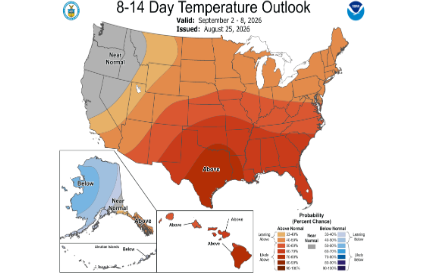
Propane hubs weakened alongside broader energy markets on Tuesday, following the bearish tone in crude oil. Spot prices are approaching six-month lows as weather conditions and underlying fundamentals continue to weigh on the market.
The EIA is expected to report a 1.5 million-barrel increase in U.S. propane inventories on Wednesday for the week ended August 21, according to the average estimate from an OPIS survey.
Why Have Oil Prices Fallen So Sharply?
Oil prices have fallen sharply over the past few days, with Brent crude down roughly 9–10% and WTI also posting significant losses. The decline is primarily the result of geopolitical risk coming out of the market, rather than a sudden surge in new oil supplies.
A major factor is growing hope that the Strait of Hormuz could reopen to safer navigation. Iran and Oman are discussing a temporary arrangement that could improve shipping conditions and potentially clear mines. Because Hormuz normally carries about 20% of globally traded oil, even the possibility of restored traffic reduces fears of a prolonged supply shortage.
Markets are also pricing in a lower chance of major U.S.–Iran military escalation. Recent U.S. sanctions were viewed as economic pressure rather than an immediate threat to Iranian oil exports, helping reduce the “war premium” that had been built into crude prices. Traders who had bought oil during the earlier surge are also taking profits, accelerating the decline.
At the same time, demand remains a concern. The IEA expects global oil demand to decline in 2026, while high fuel prices and disruptions around Hormuz could further weaken consumption.
Importantly, the physical oil market has not suddenly returned to normal. Hormuz traffic remains well below normal levels, and global inventories have been falling. The market is essentially saying that while the supply situation remains tight, there is now a reasonable chance the crisis can be resolved.
That is why oil can fall 8–10% in just a few days: traders are removing the risk premium they had added when they feared a prolonged supply crisis. If diplomacy succeeds and shipping through Hormuz normalizes, prices could remain under pressure. If negotiations fail or tensions escalate again, that risk premium could quickly return.
Fun

Disclaimer: The data, information and related graphics (collectively, “Information”) is for general information use only and is compiled from sources believed to be reliable. Dale Petroleum Company does not guarantee its accuracy or completeness, nor does DPC assume any liability for any inaccurate or incomplete information. The Information is not intended to be a research report nor an analysis of a company and it should not be relied upon for making investment decisions. The information is subject to change without notice, is for general information only and is not intended as any offer or solicitation with respect to the purchase or sale of any financial instrument or as personal investment advice.