Market Pulse
Commercial crude inventories increased by 3.0 million barrels last week, but total crude stocks fell by 3.2 million barrels due to continued Strategic Petroleum Reserve (SPR) releases. U.S. crude exports were unexpectedly weak.
Gasoline inventories declined by 1.9 million barrels and remain 17.9 million barrels below year-ago levels, while diesel inventories fell 5.0 million barrels on strong demand and exports. Propane stocks also declined by 0.8 million barrels as exports remained robust at 2.616 million barrels per day. Propane inventories now hold only a 12 million-barrel surplus versus last year. Continued export strength should limit inventory builds, although stocks could still approach 100 million barrels by the end of July.
The EIA reported commercial crude inventories at 411.4 million barrels, 6% below the five-year average. Crude prices moved sharply higher following renewed geopolitical tensions in the Middle East, with Brent and WTI both gaining more than 4% on the day.
Overall, the report remains supportive for refined products, with gasoline, diesel, and propane inventories continuing to tighten despite the unexpected build in commercial crude stocks.
Fundamentals
EIA’s Weekly Petroleum Inventory in MM’s BBLS
| Commodity | US Inventory | Change | 5 Yr Ave | CURRENT MARKETS |
|---|---|---|---|---|
| Crude Oil | 411.4 | 3.0 | 441 | WTI Crude: 5.61 |
| Gasoline | 212.1 | -1.9 | 229 | RBOB: 0.1955 |
| Distallates | 103.6 | -5.0 | 118 | Heating Oil: 0.4635 |
| Commodity | US Inventory | Change | Midwest Invent | Change |
|---|---|---|---|---|
| Propane | 90.5 | -0.8 | 22.1 | 0.6 |
Propane
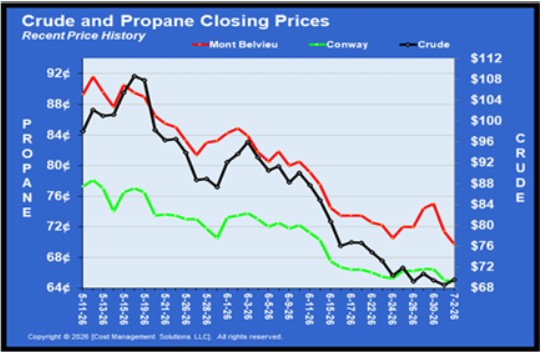
Mont Belvieu propane experienced a notable decline compared with Conway and relative to crude prices. Despite the recent move lower, inventories remain above the five-year average. The sharp decline at Mont Belvieu also narrowed the North/South spread to just over four cents.
Propane exports to both Asia and Europe have declined in recent weeks, resulting in lower Gulf Coast loadings. However, despite weakening demand from these markets, U.S. exports remain nearly 25% higher since the start of the U.S.-Iran conflict. The U.S. Gulf Coast has helped offset a portion of the lost supply, but its ability to fully replace disrupted volumes remains limited, with total global trade down approximately 13%.
Straight of Hormuz Tensions Escalate
Security concerns in the Strait of Hormuz intensified over the past 48 hours after multiple commercial tankers were reportedly attacked while transiting the vital shipping corridor. The incidents damaged several vessels, including an LNG tanker, prompting some shipowners to delay or reroute cargoes and increasing insurance costs.
Despite the heightened tensions, the Strait remains open and tanker traffic continues, although with greater caution. Approximately 20% of the world’s crude oil and LNG trade passes through the Strait of Hormuz, making any disruption a significant concern for global energy markets.
The attacks have also fueled geopolitical tensions, with President Donald Trump declaring the U.S.-Iran ceasefire over and warning of additional military action if shipping continues to be targeted.
Crude oil prices responded immediately, with both Brent and WTI rising more than 4% as traders priced in the increased risk of supply disruptions. While global oil flows have not been materially interrupted, the situation remains highly fluid, and further escalation could lead to greater volatility in energy markets.
Humor

Disclaimer: The data, information and related graphics (collectively, “Information”) is for general information use only and is compiled from sources believed to be reliable. Dale Petroleum Company does not guarantee its accuracy or completeness, nor does DPC assume any liability for any inaccurate or incomplete information. The Information is not intended to be a research report nor an analysis of a company and it should not be relied upon for making investment decisions. The information is subject to change without notice, is for general information only and is not intended as any offer or solicitation with respect to the purchase or sale of any financial instrument or as personal investment advice.