Market Pulse
U.S. crude oil inventories increased by 3.1 million barrels for the week ending April 3, according to the U.S. Energy Information Administration (EIA), bringing commercial stockpiles to 464.7 million barrels, about 2% above the five-year average for this time of year; this follows a reported 3.719 million-barrel build from the American Petroleum Institute (API). Oil prices fell sharply amid news of a two-week ceasefire between Iran and the United States, which is expected to allow limited transit through the Strait of Hormuz, with Brent crude trading at $94.37 per barrel (down $14.90 on the day and roughly $7 week over week) and WTI at $95.21 (down $17.74). Meanwhile, motor gasoline inventories declined by 1.6 million barrels as production fell to 9.4 million barrels per day, and middle distillate inventories dropped by 3.1 million barrels with production steady at 5.0 million barrels per day, leaving distillate stocks 5% below the five-year average. Total products supplied, a proxy for U.S. oil demand, averaged 20.8 million barrels per day over the past four weeks, up 6.3% year over year, with gasoline demand averaging 8.7 million barrels per day and distillate demand averaging 4.0 million barrels per day, an increase of 4.8%.
Fundamentals
EIA’s Weekly Petroleum Inventory in MM’s BBLS
| Commodity | US Inventory | Change | 5 Yr Ave | CURRENT MARKETS |
|---|---|---|---|---|
| Crude Oil | 464.7 | 3.1 | 455 | WTI Crude: -2.40 |
| Gasoline | 239.3 | -3 | 237 | Heating Oil: -0.1132 |
| Distallates | 114.7 | -3.1 | 121 | RBOB: -0.1097 |
| Commodity | US Inventory | Change | Midwest Invent | Change |
|---|---|---|---|---|
| Propane | 77.6 | 0.6 | 14.9 | 0.4 |
Propane
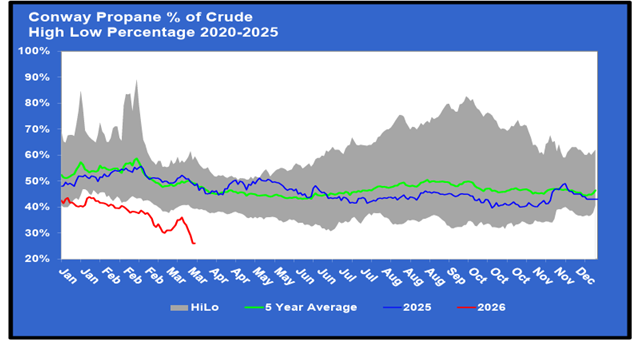
Propane spot and futures pricing continue to struggle to establish stability, remaining largely disconnected from recent gains in crude oil. Softening domestic heating demand, coupled with interruptions at export terminals, has contributed to sustained low prices. Propane’s value relative to crude is currently at six-year lows. With inventories already at record-high levels and ongoing price incentives encouraging increased crude drilling—thereby expanding propane supply—this dynamic is unlikely to change in the near term. At present, propane is notably undervalued compared to most other hydrocarbons.
Iran War
The seesaw continues. The recently announced ceasefire between the United States and Iran is a temporary two-week pause in hostilities rather than a comprehensive agreement, aimed at halting several weeks of escalating conflict and creating space for negotiations. The core provisions include a mutual cessation of attacks and a partial reopening of the Strait of Hormuz, though the latter remains conditional, with Iran asserting that transit will be subject to coordination and oversight rather than fully unrestricted access. Key details of the agreement remain disputed, as the United States has characterized the arrangement as enabling freer navigation, while Iran maintains a more controlled interpretation. Significant unresolved issues persist, including Iran’s demands for sanctions relief, recognition of its nuclear program, the release of frozen assets, and a reduced U.S. military presence in the region. The geographic scope of the ceasefire is also unclear, particularly regarding whether it extends to proxy conflicts such as those involving Israel and Lebanon. On-the-ground conditions remain fragile, with reports of minor violations and continued caution among global shipping firms, limiting an immediate return to normal transit flows. Formal negotiations are expected to begin shortly, likely in Islamabad, but both sides are approaching talks with considerable mistrust and continue to frame their positions as strategic victories while keeping military options available. Overall, the ceasefire represents a tenuous and reversible de-escalation, with its durability, and the prospects for a broader agreement remaining highly uncertain.
This remains a highly volatile situation, with external actors capable of disrupting any progress achieved over the past 24–48 hours. Notably, emerging reports suggest a potential response from Iran to Israel’s recent strikes in Lebanon. Should this materialize, market conditions could shift rapidly.
Funny
Disclaimer: The data, information and related graphics (collectively, “Information”) is for general information use only and is compiled from sources believed to be reliable. Dale Petroleum Company does not guarantee its accuracy or completeness, nor does DPC assume any liability for any inaccurate or incomplete information. The Information is not intended to be a research report nor an analysis of a company and it should not be relied upon for making investment decisions. The information is subject to change without notice, is for general information only and is not intended as any offer or solicitation with respect to the purchase or sale of any financial instrument or as personal investment advice.